Northern Whitecedar
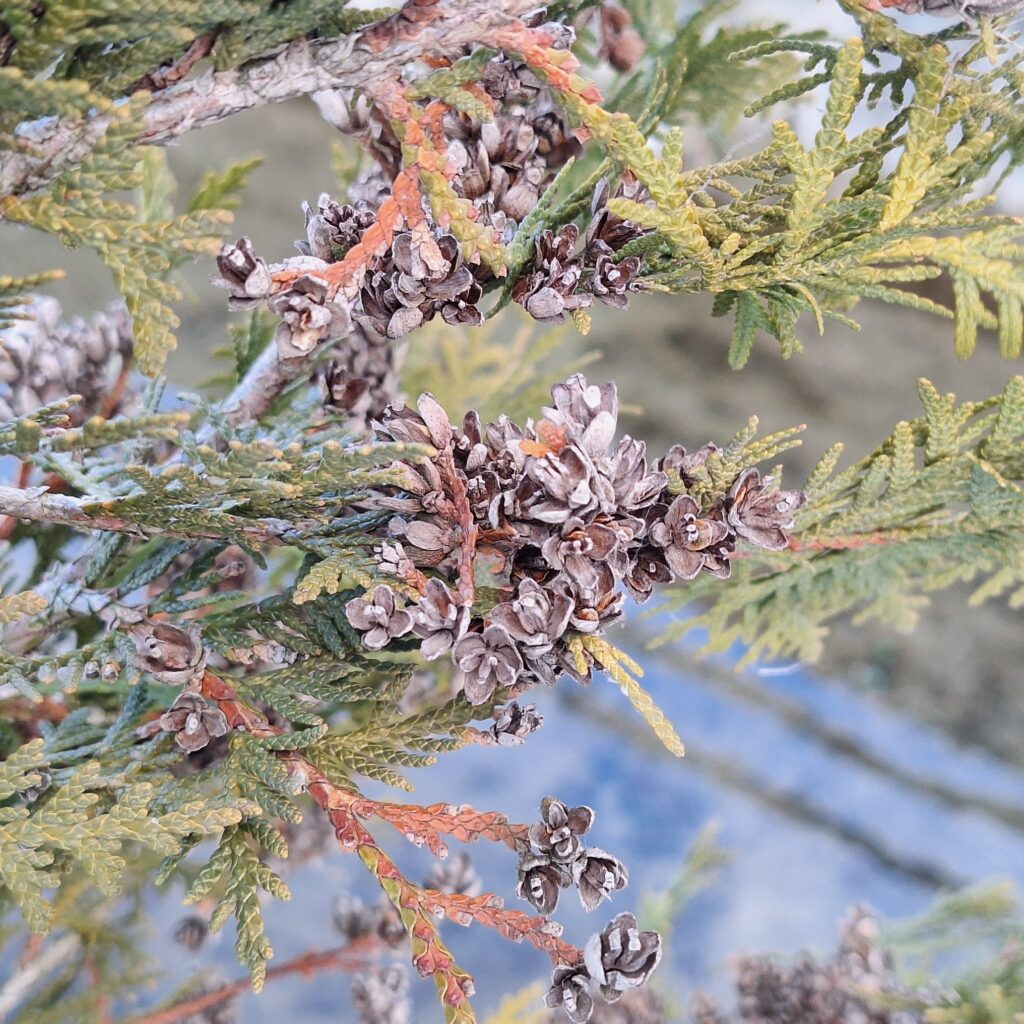
Basic Information
Scientific Name: Thuja occidentalis
Plant Family: Cupressaceae
Conservation / Invasive Status: Least Concern
Geographic Range: Northern New England
Safety Level: Use with Caution
Harvest Season: Fall, Spring, Summer
Parts Used: Bark, Branches, Buds, Leaves
Scientific & Botanical Information
Active Compounds
Northern Whitecedar’s essential oil contains significant concentrations of thujone (15-50%), fenchone (10-25%), borneol (5-15%), and camphor (2-8%), along with alpha-pinene and other monoterpenes. The essential oil is the primary bioactive fraction. Polysaccharides in the plant material may also contribute immunological effects. These constituents are well-characterized in phytochemical literature.
What Science Shows
Northern Whitecedar demonstrates documented immunostimulatory activity, particularly through its polysaccharide fraction, which activates natural killer cells and enhances interferon production. Antifungal properties are well-established against common dermatophytes and Candida species. Antiviral activity has been demonstrated in vitro and in some clinical contexts, particularly for herpes simplex virus. The high thujone content requires careful dosing to avoid neurotoxicity. Modern clinical use is limited but supported by laboratory evidence.
Growing in New England
Northern Whitecedar is a slow-growing native conifer, preferring moist, often swampy soils and cool climates throughout New England. It establishes readily from seed and is very hardy, tolerating wet conditions where most conifers fail. The narrow, columnar form makes it ideal for hedgerows and windbreaks. Growth is slow (6-12 inches annually) but reliable. It thrives in full sun to partial shade and reaches 40-60 feet in forest settings.
Safety & Interactions
Thujone is neurotoxic at high doses and can cause seizures, tremors, and kidney damage with chronic excessive use. Internal use should be limited to short-term applications (2-4 weeks) and avoided during pregnancy and breastfeeding. The essential oil should never be used internally without professional guidance. External applications are generally safe. Individuals with seizure disorders should avoid this plant. No significant drug interactions documented, but use with caution alongside medications metabolized by CYP3A4.
New England Specific
Thuja occidentalis is native throughout New England, particularly abundant in northern forests, swamps, and wetland edges. It is a keystone species in boreal-transition forest ecosystems. The wood has been harvested traditionally for canoe construction and is still valued for its rot-resistant properties. Northern populations are well-adapted to New England’s climate extremes.
Pharmacological Actions: Anti-inflammatory, Antimicrobial, Antioxidant, Antiviral, Expectorant, Immunomodulatory
Traditional Herbalism Information
Parts Used & Their Applications
The entire aerial portion is medicinal: young tips (spring), leaves, and bark are harvested and used fresh or dried. The essential oil is extracted by distillation. Historically, the Haudenosaunee peoples (Iroquois Confederacy) valued this tree as “Onnontio” or “Tree of Life” for its broad spectrum of applications. Inner bark, twig tips, and leaf material were the traditional preparations.
Preparation Methods
Traditional infusions of fresh or dried tips (1 teaspoon per cup, steeped 5-10 minutes) are the most common preparation. Decoctions of bark are stronger but require longer steeping. The essential oil was traditionally used externally as a rub or inhalation. Cold infusions were sometimes preferred to preserve volatile constituents. Tinctures in alcohol extraction the thujone efficiently. Modern practitioners often use standardized extracts and herbal blends rather than whole plant preparations to control thujone dosing.
Traditional Applications
Haudenosaunee peoples used Thuja occidentalis for respiratory support, particularly for cough and congestion. It was valued as an antifungal remedy for skin conditions and as a general immune supporter. The bark was used for rheumatism and joint pain. Women’s health applications included support for menstrual regulation and female reproductive concerns. It was also used externally for warts, verrucae, and fungal infections. Historical documentation by Moerman (1998) confirms these applications across multiple northeastern indigenous cultures.
Modern Adaptations
Contemporary herbalists use Northern Whitecedar primarily for immune support during acute respiratory challenges, typically in blended formulas to limit thujone exposure. It is incorporated into herbal remedies for fungal conditions (oral or topical), viral infections, and immune enhancement. Modern practitioners emphasize short-term use, professional guidance, and careful dosing due to thujone concerns. European Commission E monographs recognize it for upper respiratory tract conditions and skin care, though use is restricted.
New England Specific
New England herbalists have maintained knowledge of local Thuja use, often learning from indigenous sources and regional herbal traditions. Its ready availability as a native plant makes it an accessible herbal resource throughout the region. Local ethical harvesting practices emphasize sustainable collection from abundant populations.
Harvest Notes
Best harvested in spring (April-May) when new growth is most vigorous and volatile oil content peaks. Young tips and tender leaves are preferred over woody stems. Sustainable harvest involves taking only 10-15% of foliage from any single tree and spacing harvest across multiple trees. Bark harvest should be minimal and never girdle the tree. Dried material should be used within one year to preserve volatile constituents.
Traditional Uses: Antimicrobial, Antiviral, Immune Support, Respiratory Support, Wart Treatment
Magical Correspondences Information
Magical Correspondences
Northern Whitecedar carries the combined energies of Jupiter (expansion, protection, success) and Moon (intuition, dreaming, receptivity). Its Haudenosaunee name “Tree of Life” signals its role as a sacred connector between worlds. The evergreen nature suggests eternal life, regeneration, and continuity. The aromatic essential oil amplifies spiritual communication and elevates consciousness.
Magical Intentions
This plant is powerful for protection magic, grounding, spiritual cleansing, and awakening intuitive abilities. The strong aromatic properties make it ideal for smudging and space clearing work. Magical applications include protection of home and property, immune support (on magical and physical levels), spiritual purification, and connection to ancestral wisdom. Used for manifestation work grounded in survival and protection rather than superficial gain.
Ritual Uses
Northern Whitecedar is traditionally burned as smudge or incense for cleansing spaces and objects. Fresh twigs are placed on altars for protection and grounding. The wood can be used to craft wands, staffs, or ritual tools. Essential oil is incorporated into anointing oils for spiritual work. Dried tips are added to charm bags for home protection. As a native tree in New England, it is particularly powerful in land-based ceremonies and acknowledgments.
Color Correspondences
Deep green foliage carries earth, growth, and healing energy. The warm brown bark and wood suggest grounding, stability, and connection to the forest floor. Together they create a balanced protective signature, neither aggressive nor passive but steadfast and reliable.
Sabbat Associations
Northern Whitecedar’s evergreen nature makes it central to winter solstice (Yule) celebrations, representing the promise of spring’s return and eternal life. Its protective properties align with Imbolc (February 1) for home and self-protection magic. Spring gathering of new growth connects to Beltane and May Day fertility magic.
Traditional Lore & Folk Magic
Haudenosaunee tradition honored this tree as sacred and central to survival and spiritual well-being. Its “Tree of Life” designation suggests its role in ancient plant-spirit relationships and shamanic practice. The strong aromatic properties were understood to repel negative influences and attract beneficial spirits. Folk tradition valued it for house protection and cleansing of sick rooms.
Combining with Other Plants
Northern Whitecedar combines powerfully with other protective conifers (Pine, Spruce, Fir) in smudge blends. It grounds and stabilizes the work of more ethereal herbs (Mugwort, Yarrow). In protection sachets, it pairs well with Juniper, Rosemary, and other antiseptic aromatic plants. Its Jupiter nature harmonizes with other Jupiter herbs (Sage, Bay Laurel) for expansion and success work.
Planetary Rulers: Saturn
Magical Intentions: Banishing, Healing, Protection, Purification, Strength
Elemental Associations: Earth
1. Naser B, et al. (2005). Thuja occidentalis (Arbor vitae): A Review of its Pharmaceutical, Pharmacological and Clinical Properties. Evidence-Based Complementary and Alternative Medicine, 2(1), 69-78.
2. Pennachio M, Jefferson L, Havens K. (2010). Uses and Abuses of Plant-Derived Smoke. Oxford University Press.
3. Moerman DE. (1998). Native American Ethnobotany. Timber Press.
4. Duke JA. (2002). Handbook of Medicinal Herbs, 2nd Ed. CRC Press.
5. Health Canada. (2007). Monograph: Thuja occidentalis. Natural Health Products Directorate.
6. PDR for Herbal Medicines. (2007). Thuja leaf. Thomson PDR.