Canada Lily
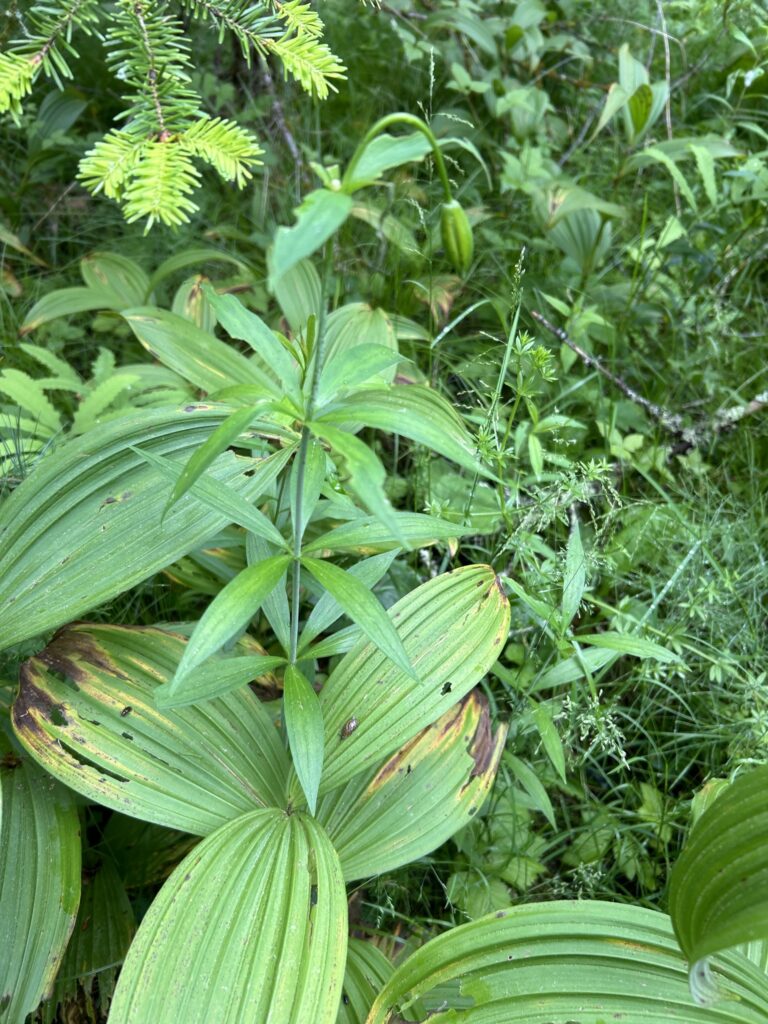
Basic Information
Scientific Name: Lilium canadense
Plant Family: Liliaceae
Conservation / Invasive Status: Least Concern
Geographic Range: Northern New England
Safety Level: Generally Safe
Harvest Season: Summer
Parts Used: Bulbs, Flowers, Roots
Scientific & Botanical Information
Active Compounds
Canada Lily (Lilium canadense L.) bulbs contain various alkaloids, though the exact alkaloid profile and concentrations have not been thoroughly characterized in modern pharmacological literature. The genus Lilium is known to contain cardiac glycosides, saponins, and various alkaloid compounds, with specific concentrations varying by species. Canada Lily bulbs contain polysaccharides and starches, contributing to their nutritional value as a food source. The flowers contain volatile oils and pigment compounds responsible for the plant’s distinctive orange-red coloration. The bulbs contain mucilaginous compounds that may contribute to demulcent properties. Research on alkaloid content in Lilium species remains limited compared to other plant families, with much of the existing literature focusing on ornamental varieties rather than medicinal applications. The exact chemical profile of Canada Lily remains inadequately documented in modern phytochemical databases, representing an important gap in botanical knowledge for this indigenous North American species.
What Science Shows
Modern pharmacological research specifically on Lilium canadense is virtually nonexistent. The limited scientific attention reflects both the plant’s relative obscurity in contemporary herbal practice and conservation concerns that have limited research access to living populations. Most understanding of Canada Lily’s properties derives from ethnobotanical documentation of indigenous uses rather than from controlled clinical studies or pharmacological analysis. The presence of alkaloids and saponins suggests potential bioactivity, but without proper chemical characterization and clinical validation, such effects remain theoretical. Some related Lilium species have been studied for potential antitumor or antimicrobial properties, but no such research has been conducted on Canada Lily specifically. The bulbs’ value as a food source is well-documented, but any medicinal properties remain unproven and unvalidated by modern scientific standards. This plant represents an important opportunity for future ethnopharmacological research focused on documenting the chemical composition and validating traditional uses of North American indigenous plants.
Growing in New England
Canada Lily is a native New England perennial, found in wetland margins, swamp edges, and moist meadows throughout the region. The plant grows from an underground bulb, producing an annual stem that reaches 2-8 feet in height depending on growing conditions and population genetics. Canada Lily prefers consistently moist but not waterlogged soils, thriving in partial shade to full sun conditions with adequate moisture. The plant is long-lived, with established bulb populations persisting for decades. Flowering occurs in mid to late summer (July-August), with distinctive orange-red nodding flowers attractive to pollinators. The plant naturally establishes populations through both bulb division and seed production, though seed germination is slow and may require several years before bulbs reach flowering size. Habitat loss and over-collection for ornamental purposes have reduced Canada Lily populations significantly in many areas of New England, making the species a conservation concern in some regions. The plant’s ecological role in wetland ecosystems remains incompletely understood, though its flowers support important pollinators.
Safety & Interactions
The alkaloid and potentially cardiac glycoside content of Canada Lily bulbs makes them concerning for internal consumption without thorough pharmacological safety evaluation. Indigenous peoples processed bulbs before consumption, with processing methods potentially reducing or eliminating alkaloid content, but modern consumption protocols remain undefined. Pregnant and nursing individuals should absolutely avoid Canada Lily due to potential alkaloid effects on fetal development and infant safety. The plant should not be harvested from wild populations due to conservation concerns. No toxicological studies have been conducted on Canada Lily, making safety assessment impossible based on current knowledge. Skin contact with bulbs or crushed plant material may provoke irritation in sensitive individuals. No drug interactions have been documented, primarily because controlled studies of any kind on this plant are absent. The conservation status of Canada Lily in many New England regions argues against any use beyond observation and protection.
New England Specific
Canada Lily is native throughout New England and represents one of the region’s most distinctive wild lilies. The plant’s orange-red flowers are iconic symbols of New England wetlands in mid-summer. Indigenous peoples of New England harvested and processed Canada Lily bulbs as a dietary staple, with evidence of this practice extending back thousands of years. Contemporary New England practitioners recognize the plant primarily through an ethically constrained lens—the species is sufficiently rare in many areas that harvesting for any purpose is inappropriate. The plant’s presence in New England landscapes connects modern practitioners to ancestral relationships with the land and to the broader ecology of native wetlands. For contemporary New England herbalists, Canada Lily represents a plant whose knowledge is worth preserving even when direct use is ethically contraindicated, maintaining continuity with indigenous knowledge while protecting the species.
Harvest Notes
Harvest of Canada Lily is not recommended due to conservation concerns in many New England populations. In areas where populations are sufficiently abundant that modest harvesting would not threaten population viability, bulbs can be harvested in autumn after the aerial portions have died back. However, given the uncertainty regarding many local populations’ conservation status, the safest recommendation is to practice protection rather than harvesting. Seeds can be collected without damaging the plant and shared with native plant restoration projects. Observation and documentation of local populations, with the goal of understanding their health and trends, serves contemporary New England practitioners more effectively than harvesting.
Pharmacological Actions: Antioxidant, Nutritive
Traditional Herbalism Information
Parts Used & Their Applications
Canada Lily bulbs constituted the primary plant part used by indigenous peoples of the Northeast, harvested and processed as a dietary staple. The bulbs were traditionally cleaned, often roasted or boiled to reduce or eliminate any strong-tasting or potentially irritating alkaloid compounds, and then consumed as a nutritious food source. The flowers, while edible and traditionally used as a condiment or flavoring, are less significant from a nutritional perspective than the bulbs. The entire plant, including stems and roots, was occasionally employed in traditional medicine preparations, though documentation of specific medicinal applications remains sparse. The processing methods employed by indigenous peoples—which typically involved extended cooking or soaking—suggest that traditional uses involved modification of raw plant compounds through preparation techniques.
Preparation Methods
Traditional preparation of Canada Lily bulbs involved roasting in fire pits or boiling in water, with the cooking process likely reducing or eliminating the alkaloid content. Some ethnobotanical records suggest that bulbs were dried for storage and later rehydrated and cooked when needed. Fresh bulbs could be peeled and consumed immediately or preserved through drying for winter use. Modern practitioners, recognizing both the conservation concerns and the inadequate documentation of the plant’s safety profile, rarely prepare Canada Lily. Should future research validate traditional processing methods and safety profiles, decoction of properly processed bulbs would presumably be the most appropriate preparation method. Until such research occurs, any preparation of wild-harvested bulbs remains experimental and potentially unsafe.
Traditional Applications
Canada Lily bulbs were traditionally employed primarily as a nutritive food, providing substantial calories and nutrients to indigenous peoples of the Northeast. Some ethnobotanical records suggest traditional medicinal uses for the bulbs in supporting childbirth and recovery from childbirth, though the documentation remains fragmentary and the specific properties addressed remain unclear. Other records indicate use in wound care and infection prevention, with the bulbs applied as a poultice to injured areas. Traditional applications as a strengthening tonic for individuals recovering from illness are mentioned in some ethnobotanical sources. The plant’s use appears to have been more food-focused than medicine-focused in traditional indigenous practice, reflecting the plant’s primary value as a calorie-dense nutritive resource.
Modern Adaptations
Contemporary herbalism has essentially abandoned Canada Lily, primarily due to conservation concerns but also due to inadequate documentation of traditional uses and complete absence of modern pharmacological validation. Modern herbalists recognize that working with this plant ethically requires placing conservation before personal use. Some contemporary practitioners focus on supporting habitat restoration and population monitoring rather than direct plant use. Indigenous herbalists and plant knowledge holders continue to work with Canada Lily where population conditions support harvesting, maintaining continuity with ancestral knowledge. Contemporary research efforts focused on ethnopharmacological study of this and other North American indigenous plants remain limited but important for future knowledge development.
New England Specific
For New England practitioners, Canada Lily represents an opportunity to develop respectful relationships with plants that were historically important to indigenous peoples while practicing conservation-based herbalism. The plant’s presence in New England wetlands connects contemporary practice to thousands of years of human interaction with the land. Rather than harvesting, modern New England practitioners can focus on habitat protection, population monitoring, and education about the plant’s historical significance. Some New England native plant societies maintain seed collections and propagation programs aimed at restoring Canada Lily populations in appropriate habitats, providing opportunities for practitioners to contribute to conservation while maintaining connection with the plant.
Harvest Notes
Contemporary ethical practice suggests avoiding harvest of Canada Lily from wild populations in most New England locations. In the rare circumstance of working with populations known to be sufficiently abundant that harvesting would not threaten population viability, bulb harvest occurs in autumn after aerial senescence. Seed collection, by contrast, can be conducted without affecting bulb viability and is an appropriate way to contribute to conservation efforts. Documentation of wild populations—recording location, population size, and health indicators—provides valuable scientific information while respecting the plant’s need for protection.
Traditional Uses: Nutritive, Traditional Food Source
Magical Correspondences Information
Magical Correspondences
Canada Lily carries Moon correspondence, reflecting the plant’s association with femininity, intuition, and the cycles of growth and rest. The Water element association is natural, given the plant’s preference for moist wetland habitats. The distinctive orange-red color of many Canada Lily varieties suggests additional correspondence to Mars, representing protection and boundaries. Some traditions assign lily flowers to the planet Venus, honoring the plant’s beauty and its role in attraction. The flower’s nodding posture has led some practitioners to associate lilies with surrender, release, and acceptance of what is beyond personal control. The bulb, hidden beneath the soil, corresponds to the unconscious mind and to the hidden roots of intention. In some traditions, lilies are considered sacred to the divine feminine principle in various cultural expressions.
Magical Intentions
Canada Lily serves as an ally in workings focused on protection, particularly the kind of protection that allows growth while maintaining boundaries. The plant supports magic designed to facilitate safe passage through transitions and transformations. Practitioners employ Canada Lily in workings focused on femininity, intuition, and the cultivation of inner wisdom. The plant is used to strengthen connection with ancestors, particularly female lineage ancestors and the indigenous peoples whose knowledge preceded contemporary practice. Canada Lily supports magic designed to restore balance and harmony to situations characterized by chaos or imbalance. The plant is employed in work focused on reverence for the earth and commitment to conservation and protection of threatened species and ecosystems. In emotional healing work, Canada Lily supports the processing of grief and the transformation of loss into wisdom.
Ritual Uses
Fresh Canada Lily flowers can be placed on altars dedicated to the goddess in her nurturing and protective aspects. The flowers are used in rituals focused on honoring ancestral knowledge and indigenous wisdom. Observing Canada Lily in its native habitat serves as a form of ritual practice—mindful attention to the plant, its life cycle, and its ecological relationships. The plant’s flowers can be dried and pressed into grimoires or spell papers intended for work focused on protection and transformation. In circle casting for work related to water, emotion, and intuition, Canada Lily flowers can mark cardinal points or create a central altar focus. The bulb itself, representing the hidden and the potential, can be used in workings focused on the development of latent power or the revelation of hidden truth.
Color Correspondences
The orange-red of Canada Lily flowers aligns with Mars energy for protection and boundaries, and with Solar energy for warmth and vital force. The orange tones also correspond to creativity, sexuality, and the sacral chakra. The green of the stem and leaves corresponds to growth, abundance, and life force. The white or pale undertones sometimes visible in the flowers correspond to clarity, purity, and spiritual insight. The reddish tones deepening to orange correspond to transformation and the alchemical work of transmuting base materials into spiritual gold.
Sabbat Associations
Canada Lily blooms in mid to late summer, making it most strongly associated with Midsummer, when the flower’s maximum power can be accessed and utilized. The plant is also relevant to Lughnasadh (Lammas), the first harvest festival, as the flowers signal the turning point toward autumn and shorter days. At Beltane, Canada Lily can be used in workings focused on crossing thresholds and safe passage through transitions. The plant’s underground bulb connects it to Samhain and the harvest season, representing the stored potential hidden in darkness. At Imbolc, the bulb represents the stirring of life beneath winter snow, the promise of spring’s return.
Traditional Lore & Folk Magic
While Canada Lily’s primary associations derive from indigenous North American tradition rather than European folk practice, the plant carries significance in contemporary witchcraft as a symbol of indigenous knowledge and the necessity of respecting both plant and human communities. The plant represents the power of what is hidden—the bulb beneath the soil containing potential for extraordinary flower and fruit. In some traditions, lilies are associated with the divine feminine and with the goddess in her nurturing and protective manifestations. The orange-red flowers of Canada Lily specifically connect to protective magic and to the power to set boundaries while maintaining connection and compassion. The plant’s modern role as a species requiring protection makes it a symbol in contemporary activism-focused witchcraft and magic focused on earth healing and ecological justice.
Combining with Other Plants
Canada Lily combines beautifully with other Moon-ruled plants such as Mugwort or Jasmine, creating a powerful trio for work focused on intuition and the unconscious. In protective work, Canada Lily combines well with Mars-ruled protective plants such as Garlic or Ginger, balancing feminine and masculine protective energies. When working with water element magic, Canada Lily pairs with other water plants such as Water Lily or the roots of plants that thrive in aquatic environments. In indigenous-honoring work focused on land and plant relationships, Canada Lily combines with other native North American plants such as Sage or Sweetgrass, creating intention around respect and reciprocity. The flowers work well in combination with other lily varieties in creating heightened magical effect. Canada Lily can be combined with Rose petals in magical work focused on the integration of beauty, protection, and deep transformation.
Planetary Rulers: Moon
Magical Intentions: Beauty, Divination, Dreams, Fertility, Love, Moon Magic
Elemental Associations: Water
1 Moerman, D. E. (1998). Native American Ethnobotany. Timber Press. 2 USDA PLANTS Database. National Plant Data Center, NRCS. Retrieved from plants.usda.gov. 3 Hoffmann, D. (2003). Medical Herbalism: The Science and Practice of Herbal Medicine. Healing Arts Press. 4 Mills, S., & Bone, K. (2005). The Essential Guide to Herbal Safety. Elsevier Health Sciences.