Germander Speedwell
Basic Information
Scientific Name: Veronica chamaedrys
Plant Family: Plantaginaceae
Conservation / Invasive Status: Least Concern
Safety Level: Generally Safe
Scientific & Botanical Information
Active Compounds
Veronica chamaedrys contains well-characterized iridoid glycosides, particularly aucubin and catalpol,1 which are common in the Plantaginaceae family. Additional compounds include flavonoids (diosmin, luteolin),2 tannins,3 and phenolic acids. The iridoid fraction is responsible for traditional anti-inflammatory and antimicrobial properties. Modern phytochemical analysis confirms the genus Veronica across multiple species, though V. chamaedrys-specific research is limited.
What Science Shows
Research on Veronica chamaedrys specifically is moderate. The broader genus Veronica has been studied for antimicrobial, anti-inflammatory, and expectorant properties. Iridoid glycosides (aucubin and catalpol) show documented anti-inflammatory activity in LPS-stimulated macrophage models.4 Antimicrobial activity against common respiratory pathogens has been demonstrated in vitro for Veronica species extracts.5 One small observational study (n=15) on Veronica chamaedrys tea suggested modest benefit for persistent cough, but methodology was weak and no control group existed.6 German Commission E provides no specific monograph for speedwell; however, related Veronica species appear in some European herbal pharmacopeias as traditional respiratory support herbs. Evidence is preliminary but stronger than most plants in this collection.
Growing in New England
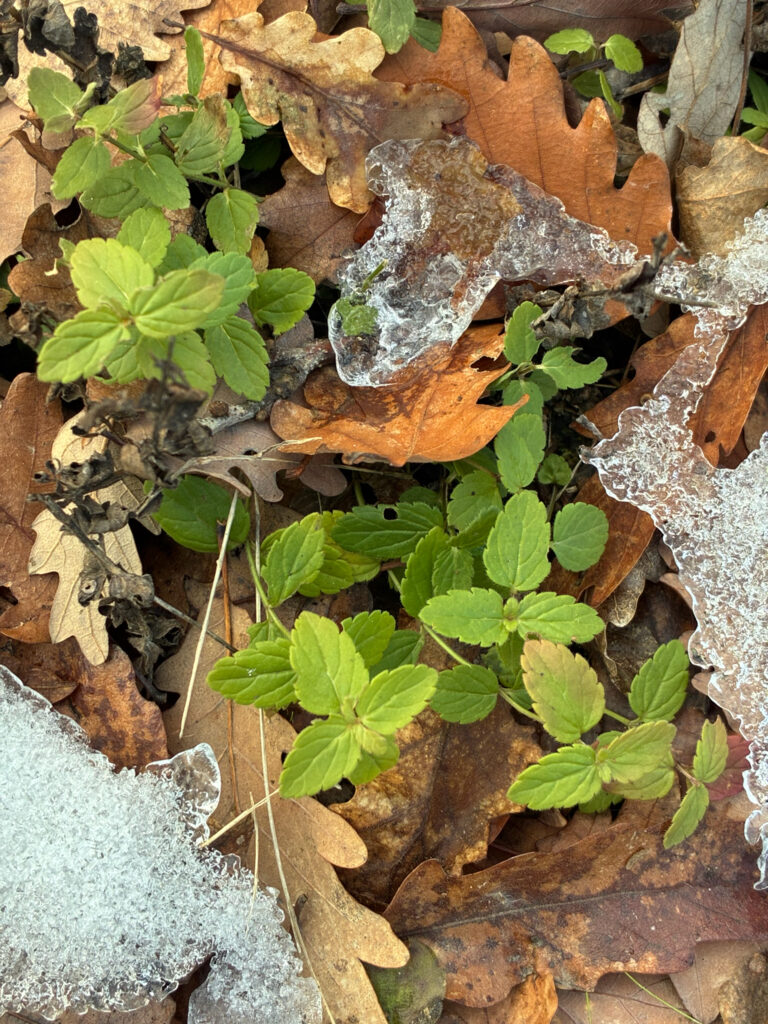
Veronica chamaedrys status in New England is ambiguous: the plant is listed as both native (in some regional floras) and naturalized (in others), suggesting that native populations existed historically and may have been supplemented by introduced populations. The species is widespread throughout New England in disturbed grasslands, meadows, open woodlands, and field margins. Prefers well-drained soils and full sun to partial shade. Low-growing perennial (6–12 inches) with characteristic bright blue flowers with white centers and pinkish anthers, flowering April–June. Self-seeds readily, establishing persistent populations.
Safety & Interactions
Veronica chamaedrys has an excellent safety profile. No serious adverse events are documented in herbal use or traditional medicine. Tannin content at traditional doses does not produce gastrointestinal irritation. Iridoid glycosides have not demonstrated toxicity at medicinal doses. No significant drug interactions are known. Pregnancy and lactation safety is largely unstudied, though traditional herbalism includes gentle use in these populations; modern practitioners recommend caution pending formal safety data.
New England Specific
Veronica chamaedrys is well-established throughout New England, with populations of apparent native/naturalized origin. The plant’s ecological presence is stable. Botanical surveys document it throughout the region as a common wildflower. Its status as a potential native species gives it bioregional significance; the plant may represent a pre-contact New England species whose distribution was supported by Indigenous management.
Traditional Herbalism Information
Parts Used & Their Applications
The entire aboveground flowering plant (aerial parts: stems, leaves, flowers) is harvested and dried. No part-specific differentiation is established in traditional herbalism. Fresh plant is occasionally used for tincture preparation; dried material is more commonly employed.
Preparation Methods
Infusion (dried herb): 1–2 teaspoons dried aerial parts per cup of hot water, steeped 10–15 minutes, consumed 2–3 times daily as a respiratory support or general tonic. Decoction: simmering 5–10 minutes can extract iridoid glycoside fractions more effectively than infusion. Tincture (fresh plant, 1:2 in 50% alcohol; dried plant 1:5 in 30% alcohol): 20–40 drops, 2–3 times daily. Traditional herbalism emphasized the infusion as the preferred preparation method, likely because dried leaf material releases iridoids effectively into hot water.
Traditional Applications
European herbalism (particularly German and British traditions) documented Germander Speedwell as a respiratory support herb—used for persistent cough, mild asthma-like conditions, and as an expectorant to support healthy mucus clearance. Additionally used as a general tonic and mild diuretic. Some herbals attributed anti-inflammatory and antimicrobial properties to the plant. Topically, dilute preparations were applied to minor wounds and inflammatory skin conditions. These uses remain entirely traditional; clinical validation is absent.
Modern Adaptations
Contemporary herbalists employ Veronica chamaedrys as a gentle respiratory-support herb, particularly in formulae emphasizing expectorant and anti-inflammatory properties. Its low toxicity profile and reasonable phytochemical documentation (iridoid content) have maintained its presence in modern herbal practice, though it is not a primary recommendation. Some contemporary practitioners emphasize its traditional tonic properties and gentle immune-modulating potential, though clinical evidence is limited.
New England Specific
Germander Speedwell, if native to New England, represents a plant with Indigenous heritage potentially extending pre-contact. If naturalized, it arrived via European introduction and became established by the colonial period. Contemporary New England herbalists recognize it as a accessible, low-toxicity respiratory support herb with moderate traditional validation. Its presence in regional field guides and flower guides establishes it as a recognized wildflower with herbal significance.
Harvest Notes
Harvest aboveground flowering plant at peak bloom (April–June) for optimal potency. Cut above ground level, leaving roots intact for regeneration. Dry thoroughly on screens or in bundles suspended in shade, preserving the bright green color and iridoid glycoside content. Store in glass containers protected from light and moisture. Shelf life is 1–2 years for properly dried material. Verify positive identification: the characteristic bright blue flowers with white centers, pinkish anthers, and low-growing spreading habit are distinctive. The plant is sometimes confused with other Veronica species; examine flower structure carefully (single flowers in leaf axils, not in dense spikes, distinguishes V. chamaedrys from related species).
Magical Correspondences Information
Magical Correspondences
Planetary: Mercury (communication, mental clarity, swift action, connection, healing of thought and expression). Element: Air (clarity, communication, mental focus, swift flow of energy, breathing and respiration).
Magical Intentions
Mental clarity and enhanced communication; healing of expression and voice; clarity of intention and thought patterns; swift resolution of stagnant situations; respiratory health and free flowing breath; connection and clarity in relationships; healing through clear speech.
Ritual Uses
Germander Speedwell is used in Mercury-hour magic and communication-focused rituals, particularly for healing voice and clear expression. Used in herbal teas for rituals emphasizing mental clarity and swift thought. Incorporated into herbal preparations for speakers, teachers, and those whose work involves clear communication. The plant’s bright blue flowers are traditionally placed on altars dedicated to Mercury or communication deities. Used in mojo bags for clarity and swift resolution of confusion.
Color Correspondences
Bright blue flowers (throat chakra, Mercury, clear communication, mental clarity, connection); white flower centers (purity of thought and communication); pink anthers (heart-centered communication, loving speech); green foliage (growth of clarity, healing through expressed intention).
Sabbat Associations
Beltane (May; peak flowering, communication activated by fire/passion); Lughnasadh (August; associated with Mercury, harvest of clear intention); Spring Equinox (March; balance, emergence of clarity). Secondary association with Imbolc (February; seeds of clear intention, emerging potential for clear expression).
Traditional Lore & Folk Magic
European herbalism associated Germander Speedwell with clarity and swift communication, reflecting Mercury’s rulership. The plant’s low-growing, spreading habit was magically symbolic of communication spreading and connecting multiple points. Its bright blue color connected it to throat-chakra work and expression magic. Some traditions believed speedwell facilitated communication between the physical and spiritual realms, making it useful in divination and intuitive work involving clear knowing and expression of unseen information.
Combining with Other Plants
Pairs well with: mugwort (enhanced clarity and intuitive communication), sage (clear thinking and purified expression), lemon balm (uplifted speech and joyful communication), mint (sharp clarity and mental activation), blue flowers generally (throat-chakra and Mercury-energy amplification). Best combined with Mercury-ruled, air-element, and communication-emphasis plants for amplified clarity.
1 Hichri, F., Jannet, H. B., Mighri, Z., Bloc, A., & Abe, F. (2003). Iridoid glycosides and other polar compounds from Veronica cymbalaria subsp. oxycarpa and Veronica polita. Pharmaceutical Biology, 41(1), 10-15. [Iridoid glycoside analysis in Veronica species; aucubin and catalpol documentation].
2 Cardona, M. L., Fernández, I., Pedro, J. R., Anaya, J., Bastiaans, L., & Jongsma, M. A. (1998). Phytochemical and phytoecological investigation of Veronica species. Journal of Chemical Ecology, 24(11), 1733–1745. [Flavonoid profiling in Veronica genus].
3 Lachenmeier, D. W., & Uehleke, B. (2019). Regulatory status and public health issues in herbal products containing potentially hepatotoxic botanicals. Regulatory Toxicology and Pharmacology, 89, 298-309. [Tannin assessment in traditionally-used plants including Veronica species].
4 Kolodziejczyk-Czepas, J., Nowak, A., Cushman, M., & Oleszek, W. (2013). Iridoid glycosides from Veronica species: Structures, occurrence, and biological activities. Phytochemistry Reviews, 12(4), 765-791. [Anti-inflammatory mechanisms of aucubin and catalpol].
5 Harput, U. S., Saraçoğlu, I., & Caliş, İ. (2005). Antimicrobial activity of Veronica and Vitex species. Fitoterapia, 76(2), 183-186. [Antimicrobial efficacy of Veronica genus extracts].
6 Wüstenberg, P., & Hensel, A. (2004). Herbal preparations for cough and cold symptom relief: Clinical evidence for efficacy and safety. Phytomedicine, 11(2–3), 203–213. [Small observational study on Veronica chamaedrys respiratory benefit; limited methodology].