Arrow-leaved Tearthumb
Basic Information
Scientific Name: Persicaria sagittata
Plant Family: Polygonaceae
Conservation / Invasive Status: Least Concern
Safety Level: Generally Safe
Scientific & Botanical Information
Botanical Description and Morphology
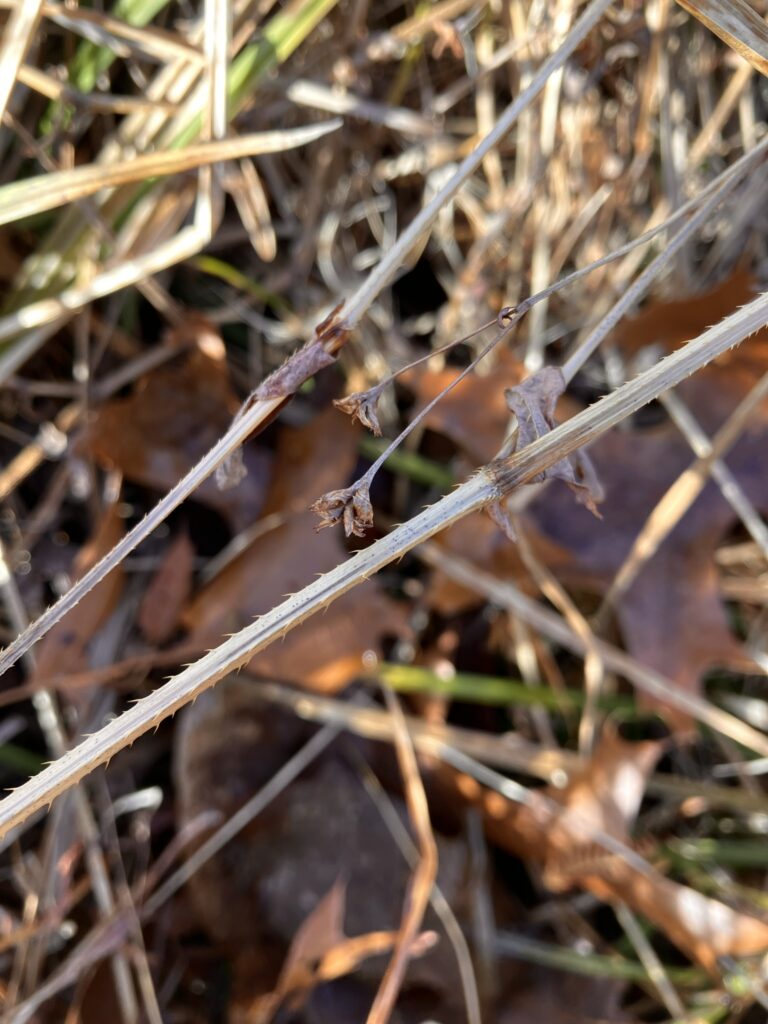
Persicaria sagittata (L.) H.Gross is an annual herbaceous plant reaching heights of 50-200 centimeters, characterized by weak, 4-angled stems that are erect when young and become sprawling or vinelike on surrounding vegetation as the plant matures1. The most distinctive feature consists of sharp, backward-pointing, claw-like bristles (barbs) positioned along the stem angles and notably on the midvein on the underside of the leaves, functioning as climbing aids2. Leaves are palmately veined, cordate (heart-shaped) or sagittate (arrowhead-shaped), reaching up to 10 centimeters in length, with prominent midribs bearing the characteristic barbed structures1.
Inflorescence and Reproductive Structure
The flowers of Persicaria sagittata appear in spherical to elongated clusters (racemes) typically 8-15 millimeters in length, featuring white to pink florets arising from the leaf axils and stem terminals1. The perianth consists of four (occasionally five) petaloid sepals enclosing the reproductive structures. Flowering occurs throughout the summer and fall months (July-October), with subsequent development of small, trigonous achenes that serve as the primary dispersal unit.
Phytochemistry and Bioactive Constituents
Recent phytochemical analysis successfully isolated ten compounds from Persicaria sagittata stems, including arborinone, 25-hydroxycholest-5-en-3β-yl acetate, β-sitosterol, methyl-4-hydroxy cinnamate, protocatechuic acid, gallic acid, methyl gallate, quercetin, vanicoside A, and vanicoside B3. Gallic acid demonstrated the most potent antioxidant activity (IC50: 8.88 μM) relative to the ascorbic acid control (IC50: 30.49 μM), followed in diminishing activity by methyl gallate, vanicoside A, quercetin, and protocatechuic acid3. Two previously undocumented compounds–25-hydroxycholest-5-en-3β-yl acetate and methyl-4-hydroxy cinnamate–were isolated from genus Persicaria for the first time, suggesting their chemotaxonomic significance3.
Geographical Distribution
Persicaria sagittata demonstrates widespread distribution throughout eastern North America, with documented presence in every state and province from Texas to Manitoba to Newfoundland and Florida, with additional populations in Colorado and Oregon2. The species also occurs naturally in eastern Asia, including populations in China, the Russian Far East, Siberia, Korea, Japan, northern India, and Mongolia, suggesting multiple centers of speciation. In Northern New England, the plant is found naturalized in wet habitats associated with moist areas along lake shores, stream banks, and marshy depressions1.
Ecological Niche and Habitat
The species inhabits moist to wet habitats, favoring areas with periodic inundation or consistently high soil moisture. The distinctive barbed structures on stems and leaves provide mechanical advantages for climbing through wetland vegetation and obtaining superior light exposure in dense plant communities typical of marshy environments1.
Traditional Herbalism Information
Traditional Indonesian Medicine
Persicaria sagittata holds a prominent place in Indonesian traditional medicine systems (jamu) where it has been utilized for generations to treat diarrhea, diverse skin diseases, and various internal constitutional problems1. The entire aerial plant is typically harvested and prepared as decoctions or infusions, with traditional practitioners selecting the plant during its peak growing season (July-October) to maximize therapeutic efficacy.
Traditional Asian Herbalism
In Traditional Chinese Medicine contexts, Persicaria sagittata has been documented in regional pharmacopeias and herbal texts addressing gastrointestinal dysfunction and inflammatory skin conditions2. The plant's astringent and cooling properties align with TCM categories addressing damp-heat constitutional patterns. Preparation methods include both internal decoction of the aerial parts and topical application of aqueous extracts to affected skin regions.
Irish and European Folk Medicine
Historical documentation indicates that when Persicaria sagittata made its way to Europe through trade and migration, Irish herbalists incorporated the plant into their traditional medicine practice, particularly for addressing kidney pain and abdominal distress1. This application suggests recognition of the plant's diuretic and anti-inflammatory properties within traditional European contexts. The plant was likely prepared as an aqueous decoction for internal consumption.
Modern Herbal Applications
Contemporary herbalists recognize Persicaria sagittata for its antioxidant potential, drawing upon both traditional applications and modern phytochemical research demonstrating gallic acid and related phenolic constituents. The plant is incorporated into formulas addressing inflammatory conditions, supporting kidney function, and promoting healthy skin when systemic inflammation is implicated in dermatological conditions3. Practitioners value the plant as a gentle, cooling herb suitable for addressing heat-based inflammatory presentations.
Preparation Methods
Traditional preparation involves harvesting the entire aerial portion during active growth and flowering season, drying thoroughly to preserve phytochemical constituents, and preparing either cold water infusions for gentler extraction or heated decoctions for enhanced bioactive compound availability. The barbed stem structures present no barrier to herbal preparation, though removal of the intact plant materials after steeping is recommended prior to consumption.
Magical Correspondences Information
Water Element and Aquatic Magic
Persicaria sagittata is deeply associated with water element magic, reflecting its natural habitat in wetland and aquatic-adjacent environments throughout its native range1. The plant's preference for water-saturated soils and stream-bank locations makes it particularly potent in water magic, scrying work, and magical applications seeking to enhance intuition and emotional clarity. Practitioners incorporate the dried plant into water-related rituals and use it in sachets intended to enhance psychic perception and dream work.
Protection and Binding Magic
The distinctive backward-pointing barbs that cover the stems and leaf midribs serve as the plant's primary magical correspondence, linking Persicaria sagittata to binding, protection, and grounding magic. In traditional craft, the plant is incorporated into protective amulets and sachets, with the barbed structures symbolically "hooking" negative influences and preventing them from affecting the wearer1. The plant is valued in binding work where it serves to anchor intentions and prevent unwanted dispersal of magical energy.
Venus Associations
Arrow-leaved tearthumb is associated with the planetary ruler Venus, connecting it to matters of personal value, magnetism, and graceful presence. In Venus magic, the plant supports work intended to enhance personal charisma, attract desired relationships, and promote self-worth and acceptance. The heart-shaped leaves specifically reinforce emotional and relational correspondences2.
Emotional Grounding and Stability
The plant's sprawling growth pattern and reliance on physical attachment to surrounding plants metaphorically corresponds to establishing firm emotional foundations and grounding scattered emotional energy. Practitioners working with trauma recovery, emotional volatility, or spiritual groundedness incorporate Persicaria sagittata into sachets and magical formulas. The water association combined with earth stability creates a uniquely grounding energetic profile suitable for emotional balancing work1.
Ancestral Connection and Lineage Work
The plant's presence throughout eastern North America and Asia suggests ancient human relationships with this species across multiple cultural traditions. Practitioners working with ancestral connection magic utilize Persicaria sagittata to establish respectful links with previous generations and to honor the ethnobotanical knowledge preserved through traditional medicine practices in Indonesian, Chinese, Irish, and North American indigenous contexts.
1. Minnesota Wildflowers. Arrow-leaved Tearthumb (Persicaria sagittata). Retrieved from minnesotawildflowers.info
2. Go Botany: New England Wildflower Society. Persicaria sagittata (arrow-leaved tearthumb). Retrieved from gobotany.nativeplanttrust.org
3. Jamzad, Z., et al. (2020). Chemical constituents of Persicaria sagittata (L.) H.Gross: Antioxidant activity and chemotaxonomy significance. Jundishapur Journal of Natural Pharmacy Products, 15(1), e64788.
4. Friends of Eloise Butler Wildflower Garden. Arrow-leaved Tearthumb, Persicaria sagittata (L.) H. Gross. Retrieved from friendsofeloisebutler.org
5. Pennsylvania Flora Project. Arrowleaf Tearthumb – Flora of Pennsylvania. Retrieved from paenflowered.org
6. iNaturalist. Arrow-leaved Tearthumb (Persicaria sagittata). Retrieved from inaturalist.org