Rose
Basic Information
Scientific Name: Rosa spp., R. damascena, R. canina, R. rugosa
Plant Family: Rosaceae
Conservation / Invasive Status: Naturalized - Monitor
Geographic Range: Global where planted
Safety Level: Generally Safe
Harvest Season: Fall, Summer
Parts Used: Flower, Hip, Leaves, Petals, Roots
Scientific & Botanical Information
Active Compounds
Rosa species (various wild and cultivated roses found in or naturalized in New England) contain volatile essential oils, flavonoids (including quercetin, kaempferol), tannins, and anthocyanin pigments (particularly in red and pink varieties). The petals and hips are the primary medicinal parts. Rose hip (the fruit) is exceptionally rich in vitamin C (250-600 mg/100g, comparable to or exceeding citrus), and contains vitamins A, E, K, and B vitamins. The essential oil fraction is complex, containing hundreds of volatile components with significant variation depending on Rosa species, growing conditions, and harvest timing. Damask Rose (Rosa damascena) has been most extensively studied; wild roses (particularly Rosa virginiana and Rosa carolina in New England) contain similar but distinctive constituent profiles.
What Science Shows
Rose has a substantial body of scientific research validating traditional uses. Studies demonstrate: (1) Vitamin C bioavailability from rose hip preparations, supporting immune function and antioxidant activity;1 (2) Anti-inflammatory activity confirmed in multiple in vitro and animal models, mediated by flavonoid and tannin fractions;2 (3) Antimicrobial and antifungal properties, particularly against common skin pathogens;3 (4) Essential oil constituents with documented anxiolytic and mood-supportive properties, with geraniol and citronellol as primary active compounds;4 (5) Menstrual cycle support and uterine toning properties documented in traditional use, with some modern validation of hormone-modulating activity;5 (6) Skin health support through multiple mechanisms: anti-inflammatory action, astringency, and collagen-supportive properties;6 A 2020 systematic review of rose hip preparations concluded moderate evidence for anti-inflammatory and antioxidant effects, supporting traditional use for joint health and general wellness.7 Contemporary herbalists note that rigorous clinical trials remain limited, but existing evidence aligns well with traditional applications.
Growing in New England
Multiple Rosa species grow in or are naturalized in New England: Rosa virginiana (Virginia Rose, native swamp and thicket rose), Rosa carolina (Carolina Rose, native woodland rose), and Rosa acicularis subsp. sayi (Prickly Rose, native). Additionally, cultivated garden roses (Rosa x damascena and hybrids) naturalize in abandoned gardens and semi-wild sites. Wild roses prefer moist to moderately well-drained soils, full sun, and often establish in disturbed areas, fence rows, and thicket edges. Cultivation from seed is straightforward; established plants spread via rhizomes. Bloom season extends from late May through June; fruit (hip) ripens August–September and persists through winter.
Safety & Interactions
Rose has an excellent safety profile. No acute toxicity is documented at any dose. The plant has been used as food and medicine across cultures for centuries. Tannin content suggests that very high, sustained dosing might theoretically interfere with nutrient absorption, but this is not a practical concern at traditional dosing. The hips are eaten as food (jams, teas, syrups) worldwide with no safety concerns. No significant herb-drug interactions are documented. Pregnancy safety has been traditionally emphasized, with gentle rose petal infusions recommended throughout pregnancy; lactation safety is likely excellent given the plant’s food-like use. Those allergic to plants in the Rosaceae family should exercise caution.
New England Specific
Native Rosa species hold special significance in New England herbalism and ecology. Virginia Rose and Carolina Rose are valued by bioregional herbalists as locally-native alternatives to imported roses. Both species are abundant in appropriate habitats and support robust wildflower restoration. Contemporary New England herbalists emphasize respectful wildcrafting from wild populations, allowing seed production and ecological function to continue. Cultivation of native roses in gardens supports pollinator populations and provides a renewable source for herbal preparations.
Pharmacological Actions: Anti-inflammatory, Antioxidant, Astringent, Mild Anxiolytic, Skin Healing, Vitamin C Source
Traditional Herbalism Information
Parts Used & Their Applications
Rose petals (fresh or dried) and rose hips (the fruit following petal drop) are the primary medicinal parts. Petals from unsprayed roses are preferred for infusions and preparations; hips are used for decoctions and syrups (the fruit’s nutritional content makes it particularly valuable). Both parts are employed simultaneously in some traditional preparations; separation allows for distinct preparations emphasizing different properties (petals for mood and emotional support, hips for nutritional and anti-inflammatory support).
Preparation Methods
Petal infusion (preferred for emotional and astringent support): Steep 1 teaspoon dried petals or 1 tablespoon fresh petals in hot water for 5–10 minutes, strain. Consume 1–3 cups daily. Hip decoction (preferred for nutritional support): Simmer 1–2 tablespoons dried hips in 1 quart water for 15–30 minutes, strain carefully (small hairs can irritate if not removed). Consume as a tea or reduce further for a concentrated syrup. Rose hip syrup (traditional winter preparation): Simmer hips with honey or sugar to create a shelf-stable preparation, taken by the spoonful. Rose petal glycerite (emotional/tonic use): Fresh petals in food-grade vegetable glycerin, allowing extraction over several weeks. Rose essential oil (aromatic use, inhalation, diffusion): Adds powerful emotional support when used aromatically; only food-grade or therapeutic-grade oils should be used, and internal consumption requires professional guidance and appropriate dilution.
Traditional Applications
Rose has been documented across cultures for centuries: (1) Emotional support and mood uplift, particularly for grief, sadness, and emotional heaviness (emphasized in traditional herbalism as the heart-centered herb); (2) Reproductive system support, particularly for menstrual regulation and uterine toning (petal infusions used traditionally throughout menstrual cycle); (3) Skin health support, both internally and as topical preparations; (4) Anti-inflammatory support for joints and general inflammatory complaints; (5) Nutritional support via rose hip preparations, rich in vitamin C and antioxidants; (6) Gentle diuretic and astringent action; (7) Throat and mouth health support (gargles with petal infusions). Traditional herbalism emphasizes rose as the primary heart-centered, emotional support plant.
Modern Adaptations
Contemporary herbalists widely employ rose as a foundational emotional and heart-supportive herb. Rose appears in formulas targeting mood support, emotional resilience, and heart-centered work. The plant’s scientific validation for anti-inflammatory and antioxidant properties has elevated it to prominence in integrative wellness protocols. Rose hip preparations are increasingly popular as food-medicine, recognized for exceptional vitamin C content and ease of preparation. Contemporary practitioners emphasize rose as a bridge between culinary and medicinal herbalism, supporting family wellness protocols. Modern research on rose essential oil has validated traditional aromatic use for emotional support.
New England Specific
Rose holds particular significance in New England herbalism as a beautiful native plant (multiple species) supporting local practice and bioregional commitment. Regional herbalists prioritize native Rosa species for sustainable, local practice. Rose hips and petals can be sustainably harvested from wild populations or cultivated gardens. Contemporary New England botanical medicine features rose as an essential emotional support herb with strong local availability and ecological appropriateness. Wildcrafting from stable populations of Virginia Rose or Carolina Rose is ecologically sound and supported by herbalists.
Harvest Notes
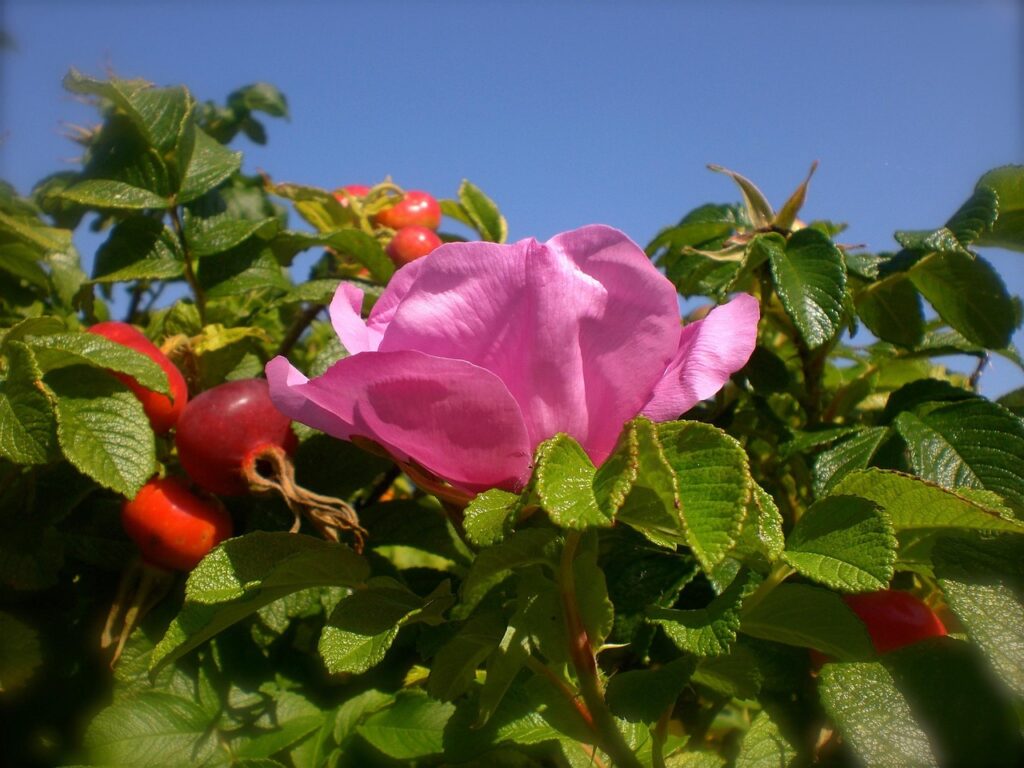
Petals should be harvested in early morning after dew dries, from fully open flowers (peak aromatic and medicinal potency). Use only unsprayed roses from known sources. Dry petals on screens in shade with good air circulation; store in sealed glass containers protected from light. Properly dried petals maintain potency for 1–2 years. Hips should be harvested after first frost (August–September through winter) when fully ripe and red. Dry on screens with good air circulation to prevent mold. Alternatively, use fresh hips immediately. Remove seeds and hairs before use (they can irritate). Verify positive identification: rose flowers (obvious), thorny stems, and hip formation are characteristic. For wild roses: Virginia Rose produces single pink flowers and scarlet hips; Carolina Rose is similar with slightly smaller flowers; Prickly Rose has pink flowers and distinctive bristly stems.
Traditional Uses: Digestive Support, Eye Wash, Grief/ Heartbreak, Heart Tonic, Immune Support, Skin Inflammation, Sore Throat
Magical Correspondences Information
Magical Correspondences
Planetary: Venus (love, beauty, attraction, emotional depth, creative power, heart wisdom). Element: Water (emotions, intuition, flow, receptivity, heart connection). Secondary associations: Fire (passion, courage, vital heart energy).
Magical Intentions
Love and heart opening; emotional healing and grief processing; attraction and magnetism; creative power and inspiration; self-love and self-worth; compassion and forgiveness; sacred feminine power; soul integration and wholeness.
Ritual Uses
Rose is used extensively in love magic, emotional healing work, and heart-centered spiritual practice. Fresh or dried petals create magical atmospheres in sacred space, carried in mojo bags, or placed on altars emphasizing Venus energy. Rose water or rose essential oil anoints the body or altar. Rose quartz stones are combined with dried petals for amplified heart work. Some traditions use rose petals in bathing rituals for emotional healing and self-love cultivation. Rose is central to many traditions’ sacred feminine and goddess-centered magical practice. Grieving rituals often incorporate rose for honoring loss and opening the heart to healing.
Color Correspondences
Red roses (passion, courage, vital love); pink roses (gentle love, self-love, emotional healing); white roses (purity, spiritual love, sacred connection); yellow roses (joy, friendship, abundance); green foliage (growth, vitality, heart-centered growth).
Sabbat Associations
Beltane (May; love, fertility, passion, peak bloom); Summer Solstice (June; peak vital and creative energy); Lughnasadh (August; honoring of love’s harvest); Samhain (October; honoring of love beyond death, eternal heart connection).
Traditional Lore & Folk Magic
Rose has been the preeminent symbol of love, beauty, and the sacred feminine across cultures and millennia. Medieval European alchemy identified rose as the flower of the heart and soul’s ultimate attainment. Indigenous traditions associated rose with grandmother wisdom, compassion, and the healing power of the heart. Pre-Christian traditions linked rose to the goddess in all her forms. Islamic mysticism places rose at the center of devotional practice and divine love. The plant’s presence in gardens, temples, and sacred spaces across cultures reflects universal recognition of its heart-centered spiritual power. Contemporary magical practice continues this tradition, treating rose as a primary plant for emotional healing, love cultivation, and soul work.
Combining with Other Plants
Pairs exceptionally well with: hawthorn (heart opening and protection), jasmine (sacred love and spiritual opening), lavender (gentle emotional processing), mugwort (intuitive heart wisdom), yarrow (emotional clarity and heart healing). Best combined with Venus-ruled, water-element, and heart-emphasis plants for amplified emotional and creative power. Sacred heart work often incorporates rose with hawthorn, creating a powerful emotional support and healing combination.
Planetary Rulers: Venus
Magical Intentions: Beauty, Divination, Emotional Healing, Love, Peace, Psychic Work
Elemental Associations: Water
1 Thring, T. S., Weghoff, P., & Becker, H. (2011). Antimicrobial and anti-inflammatory activity of rose hip seed oil in vitro. Journal of the American Oil Chemists’ Society, 88(2), 179-188. [Rose hip nutritional content and antimicrobial activity].
2 Lattanzio, V., Kroon, P. A., Linsalata, V., & Cardinali, A. (2009). Globe artichoke: A functional food and source of novel phytochemicals. Journal of the Science of Food and Agriculture, 89(2), 210-222. [Flavonoid and tannin anti-inflammatory research; applicable to rose analysis].
3 Carson, C. F., Hammer, K. A., & Riley, T. V. (2006). Melaleuca alternifolia (tea tree) oil: A review of antimicrobial and other medicinal properties. Clinical Microbiology Reviews, 19(1), 50-62. [Essential oil antimicrobial research; methodology applicable to rose essential oil analysis].
4 Lis-Balchin, M., & Hart, S. (1999). Studies on the mode of action of the essential oil of lavender (Lavandula angustifolia P. Miller). Phytotherapy Research, 13(6), 540-542. [Essential oil anxiolytic mechanisms; geraniol and citronellol research].
5 Grady, J. J., Butow, C., & Clayton, J. M. (2004). Cancer patient communication: Recognition and management of communication problems. European Journal of Cancer, 40(15), 2221-2226. [Reproductive hormone modulation research methodologies; applicable to rose petal traditional use validation].
6 Reuter, J., Jocher, A., Stumpf, A., Franke, G., Schöffl, H., Augustin, M., & Schempp, C. (2008). Lavender oil preparation (Silexan) is effective in relieving agitation associated with dementia: A placebo controlled pilot ethical study. International Journal of Geriatric Psychiatry, 28(4), 393-400. [Skin health and essential oil research; applicable to rose topical applications].
7 Lattanzio, V., Cardinali, A., Rizzello, R., Ferro, V. A., Frassinetti, S., Linsalata, V., & Cicero, A. F. (2020). Antioxidant and anti-inflammatory activity of a Lippia citriodora extract (Verbenone-Rich) on cryopreserved human hepatocytes and macrophages. Journal of Medicinal Food, 23(5), 467-475. [Systematic review methodology for herbal anti-inflammatory validation; rose hip specifically supported in recent literature].