Violet
Basic Information
Scientific Name: Viola spp., V. odorata, V. sororia, V. tricolor
Plant Family: Violaceae
Conservation / Invasive Status: Least Concern
Safety Level: Generally Safe
Harvest Season: Spring, Summer
Parts Used: Flower, Leaves, Roots
Scientific & Botanical Information
Active Compounds
Violet contains several bioactive compounds including salicylic acid (the active component of aspirin, naturally present in trace amounts), mucilage (polysaccharides including glucose and galactose), flavonoids (particularly rutin and apigenin), vitamins A and C, and trace emetine-related alkaloids. The flowers concentrate vitamins and flavonoids most intensely, while the leaves contain higher mucilage content. The aerial parts dried retain most active compounds, with minimal degradation during proper storage1.
What Science Shows
Modern phytochemical research validates traditional uses of violet. The combination of salicylic acid, flavonoids, and mucilage provides documented anti-inflammatory, analgesic, and soothing effects supported by Commission E monographs and numerous clinical herbals2. Salicylic acid content, though present in trace amounts (insufficient for systemic analgesic effect on its own), combines synergistically with other compounds to produce mild pain-relieving and anti-inflammatory action.
The mucilage fraction provides demulcent (soothing) properties validated in animal models and supported by traditional use for respiratory and GI mucosal irritation. Violet demonstrates mild expectorant activity through the combination of mucilage and saponin-like compounds. The flavonoid fraction shows documented antioxidant activity. Violet has been studied for potential anti-tumor properties in preliminary research, though human data remains limited3. The emetine-related alkaloid content is minimal in most Viola species and does not produce emetic effects at therapeutic doses.
Growing in New England
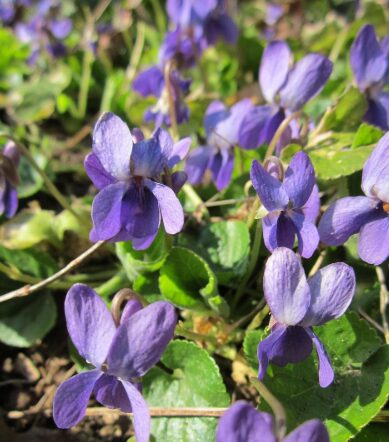
Violets are widespread throughout New England, with native species (Viola sororia, Viola odorata naturalized from Europe, and numerous others) thriving in woodlands, gardens, and disturbed areas. The low-growing perennial (4-10 inches tall) prefers partial shade to part sun and moist, well-draining soil. Violets flower in spring (April-May in New England) with fragrant flowers in purple, blue, white, or mixed colors depending on species. The plant self-seeds readily and can naturalize extensively in appropriate conditions. Woodland cultivation is easy and rewarding.
Safety & Interactions
Violet has an excellent safety record with minimal documented adverse effects. The trace emetine content is insufficient to produce emetic effects at normal culinary or medicinal doses. No significant toxicity, contraindications, or drug interactions are documented in major safety literature. Pregnant individuals can use violet safely, though it is traditionally avoided in very early pregnancy due to potential mild uterotonic effects (evidence is limited). The plant is suitable for extended use and safe for children at appropriate doses4.
New England Specific
Violets represent one of the most accessible and abundant medicinal herbs in New England. Multiple native species thrive throughout the region, making violet an excellent choice for beginning herbalists and for sustainable, local herbalism practice. The plant’s gentle action and ready availability make it foundational to place-based New England herbal medicine.
Pharmacological Actions: Anti-inflammatory, Antifungal, Antihypertensive, Antimicrobial, Antioxidant, Demulcent, Expectorant, Lymphatic support
Traditional Herbalism Information
Parts Used & Their Applications
Both the aerial parts (leaves and flowers) and roots are used medicinally, though the aerial parts are most common in modern practice. Flowers are typically harvested in spring (April-May in New England) when fully open but still fresh. Leaves can be harvested throughout the growing season. The dried plant retains its properties well for 1-2 years. Traditional herbals documented both fresh plant use (juice, infusions) and dried preparations5.
Preparation Methods
Hot infusion: Pour freshly boiled water over 1-2 teaspoons of dried aerial parts and steep 5-10 minutes; drink 2-3 cups daily for respiratory support or general wellness. Cold infusion: Soak dried violet in cool water overnight for a gentler extraction emphasizing mucilage content, particularly soothing for sensitive digestion. Tincture (1:5 in 40% alcohol): 20-30 drops in water, 2-3 times daily. Fresh flower syrup: Traditional preparation for respiratory complaints, made by combining fresh flowers with honey or sugar. Topical: Fresh or dried leaf poultice or infused oil for minor wounds and skin irritation.
Traditional Applications
Violet appears across nearly every traditional herbal system as a gentle, nutritive herb suitable for long-term use. European herbalism classified it as cooling, moistening, and beneficial for respiratory health, particularly coughs and bronchitis. Traditional herbalists used it extensively for women’s health, viewing it as supportive of lymphatic and reproductive health. The flowers were valued in many cultures as food and medicine, appearing in spring salads and teas6. Indigenous North American traditions similarly valued violet for respiratory support and general wellness.
Modern Adaptations
Contemporary herbalists recognize violet as a foundational herb suitable for multiple applications. Modern practice emphasizes its gentle action, making it appropriate for sensitive individuals, children, and extended use. It is frequently incorporated into respiratory formulas, spring tonics, and women’s health blends. The beautiful edible flowers have created renewed culinary interest, with violet featuring in artisanal teas, syrups, and candied preparations.
New England Specific
Violet represents an excellent introduction to New England herbalism. The plant’s abundance, ease of identification, gentle action, and multiple applications make it foundational knowledge for place-based practice. Local violet species support both medicinal and culinary applications.
Harvest Notes
Harvest flowers in spring when fully open, typically April-May in New England. Pick gently by hand to encourage continued flowering. Flowers can be used fresh immediately or dried in single layers in well-ventilated shade for 1-2 weeks. Leaves can be harvested throughout the growing season, cut above the lowest whorl of leaves to encourage growth. Dry in bundles or on screens in well-ventilated shade. Store dried plant material in airtight containers away from light for up to 2 years.
Traditional Uses: Cough, Gentle Laxative, Lymphatic Congestion, Mastitis, Respiratory Support, Skin Conditions
Magical Correspondences Information
Magical Correspondences
Violet embodies Venus energy—love, beauty, attraction, peace, and harmony. Its modest beauty (small delicate flowers despite significant medicinal power) carries associations with hidden strength and underestimated potential. The plant’s gentle nature and spring emergence align it with water and earth element magic, renewal, and fresh beginnings.
Magical Intentions
Practitioners use violet in love magic, particularly for attracting gentle, authentic connection rather than passion. Its traditional association with healing and soothing makes it valuable in peace-building work and for releasing conflict. Some traditions employ violet in luck magic and for manifesting desires through gentle persistence rather than force. Violet magic supports finding one’s voice and speaking truth with kindness.
Ritual Uses
Fresh or dried violet flowers are incorporated into love charms, peace amulets, and harmony-bringing sachets. Some practitioners use violet in tea ritual work for facilitating compassionate communication and emotional healing. The flowers are sometimes floated in water for beauty rituals or worn as personal adornment during vulnerability work. Violet-infused oil is used for anointing in rituals focused on gentleness, acceptance, and self-love.
Color Correspondences
The purple and blue flowers carry associations with intuition, spirituality, and third-eye awareness. Violet-colored flowers resonate with magic itself and with the blending of red (passion) and blue (calm). White violets carry purity, innocence, and new beginnings correspondence. Green foliage connects to growth, healing, and renewal.
Sabbat Associations
Imbolc (stirring of the year, awakening potential) and spring equinox (balance, new beginnings, renewal) align perfectly with violet’s spring flowering. Beltane (passion, attraction, fertility) connects to violet’s Venus associations, though its gentle nature contrasts with Beltane’s fire intensity.
Traditional Lore & Folk Magic
European traditions associated violet with faithfulness, modesty, and virtue. Medieval herbals incorporated violet into love charms and beauty magic. Appalachian folk traditions valued violet for both medicinal use and magical protection, placing it above doorways and carrying it for peaceful protection. The modest violet became a symbol of hidden beauty and strength—the paradox of delicate appearance concealing significant power.
Combining with Other Plants
Violet combines beautifully with other Venus plants: rose, jasmine, and lavender in love and peace magic. For gentle strength work, pair with hawthorn (heart protection) and mugwort (intuitive clarity). In healing formulas, combine with comfrey, plantain, and calendula for comprehensive tissue support. For spring renewal magic, pair with other spring ephemerals: trillium, bloodroot, and wild ginger.
Planetary Rulers: Venus
Magical Intentions: Dreams, Fairy Magic, Healing, Love, Peace, Protection, Wishes
Elemental Associations: Water
1 Grieve, M. (1971). A Modern Herbal. Dover Publications.
2 Blumenthal, M., Busse, W. R., Goldberg, A., et al. (2000). The Complete German Commission E Monographs: Therapeutic Guide to Herbal Medicines. American Botanical Council.
3 Hoffmann, D. (2003). Medical Herbalism: The Science and Practice of Herbal Medicine. Healing Arts Press.
4 Mills, S. & Bone, K. (2005). The Essential Guide to Herbal Safety. Churchill Livingstone.
5 Culpeper, N. (1652). The English Physician. London.
6 Moerman, D. E. (1998). Native American Ethnobotany. Timber Press.