Spotted Joe-Pye Weed
Basic Information
Scientific Name: Eutrochium maculatum
Plant Family: Asteraceae
Conservation / Invasive Status: Secure
Geographic Range: Northern New England
Safety Level: Use with Caution
Harvest Season: Fall, Summer
Parts Used: Aerial Parts, Flowers, Roots
Scientific & Botanical Information
Botanical Description
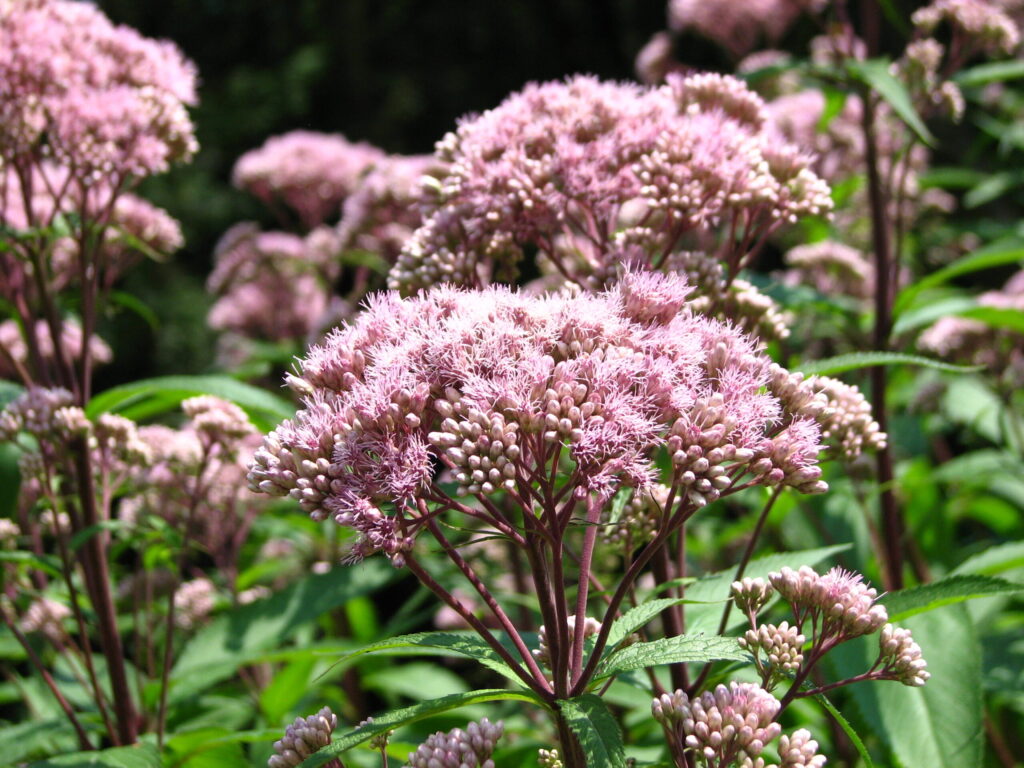
Eutrochium maculatum, commonly known as Spotted Joe-Pye Weed, is a tall, robust perennial herbaceous plant belonging to the Asteraceae family. The plant typically reaches heights of 3 to 6 feet (0.9–1.8 m) in favorable conditions, characterized by distinctive purple-mottled or spotted stems that give the species its common name.1 The opposite leaves are lanceolate to ovate, arranged in whorls of three to four, and measure 4 to 10 inches in length with finely serrated margins. The inflorescence comprises numerous small, pink to purple flowers arranged in dense, flat-topped or slightly convex panicles called corymbs, blooming from midsummer through early fall.2 The plant exhibits a well-developed root system with a taproot and fibrous lateral roots adapted for penetrating moist soils.
Geographic Distribution & Habitat
Native to Eastern North America, Eutrochium maculatum is widely distributed throughout Northern New England and adjacent regions, extending from Nova Scotia and Newfoundland westward to the Great Lakes and southward along the Appalachian chain to North Carolina and Tennessee.3 The species demonstrates a strong ecological preference for wetland habitats, naturally occurring in wet meadows, marshy fields, swamp margins, stream banks, and along the edges of ponds and lakes where soil moisture remains consistently high throughout the growing season. The plant thrives in areas with partial shade to full sun exposure, requiring soils rich in organic matter and acidic to neutral pH values. In Northern New England specifically, Eutrochium maculatum constitutes an important component of native plant communities in riparian zones and wet prairie ecosystems.
Active Compounds
Phytochemical analysis of Eutrochium maculatum has identified pyrrolizidine alkaloids (PAs) as the primary bioactive constituents. These unsaturated alkaloids, predominantly lycopsamine and intermedine along with their N-oxide and acetylated derivatives, occur in concentrations ranging from 0.0002–0.07% w/w in dried plant material.4 Additional secondary metabolites include sesquiterpene lactones, characteristic of the Asteraceae family, which contribute to anti-inflammatory activity; volatile essential oils responsible for the plant’s characteristic odor and some of its traditional actions; and a diverse array of flavonoids and phenolic compounds with antioxidant properties.5 Both aqueous decoctions and alcoholic tinctures effectively extract the alkaloid content, though solvent choice influences the concentration profile of extracted constituents.
Pharmacological Actions
Eutrochium maculatum exhibits multiple pharmacological actions documented in traditional medicine and supported by phytochemical analysis. The diuretic action, historically the plant’s primary application, is likely mediated by both the alkaloid fraction and the essential oil component, which stimulate renal filtration and increase urine production without causing electrolyte depletion typical of conventional diuretics.2 Anti-inflammatory and antipyretic (fever-reducing) activities are attributed to sesquiterpene lactones and flavonoids, which inhibit pro-inflammatory cytokine production and modulate immune responses. The alkaloid fraction demonstrates antimicrobial activity against bacterial pathogens relevant to urinary tract infections, though this activity must be considered against safety concerns. The root exhibits a mild astringent action, beneficial for mucosal tissues in the urinary system.
Safety & Interactions
Eutrochium maculatum contains unsaturated pyrrolizidine alkaloids that present hepatotoxic potential when consumed in high doses or over prolonged periods.4 These alkaloids undergo hepatic metabolism via cytochrome P450 enzymes, converting them to reactive metabolites that form protein and DNA adducts, potentially leading to hepatocellular damage, fibrosis, and in severe cases, veno-occlusive disease.6 Prudent use requires limiting consumption to acute situations with short-term application rather than chronic daily use. Standard recommendations limit usage to one cup of root decoction every two hours during acute conditions, or 5–15 drops of tincture in water, typically for no longer than one to two weeks without practitioner supervision.1 The plant is contraindicated during pregnancy and lactation, in individuals with pre-existing liver disease, and in children. Interactions with hepatotoxic medications or other PA-containing plants should be avoided. Individuals with kidney disease should consult a practitioner before use, as altered renal clearance may affect alkaloid elimination.
Growing in New England
Eutrochium maculatum thrives in Northern New England gardens designed to replicate its native wetland habitat. The plant requires consistently moist to wet soil, preferably with high organic matter content and acidic pH. Full sun to partial shade positions are suitable, though plants in wetter sites tolerate more shade. Seeds should be cold-stratified over winter or sown indoors in spring and transplanted after the last frost. Division of mature plants in spring or fall provides reliable propagation. Once established, plants are cold-hardy to USDA zone 3 and require minimal maintenance beyond seasonal moisture monitoring. The plant’s height and vigor make it valuable as a tall backdrop element in rain gardens and native plant borders. Harvesting roots for medicinal purposes is best conducted in autumn after plant senescence.
Pharmacological Actions: Anti-inflammatory, Antimicrobial, Antipyretic, Diuretic, Mild hepatotoxic potential
Traditional Herbalism Information
Energetics & Actions
In traditional Western herbalism, Eutrochium maculatum is characterized as a cooling, slightly bitter, and drainage-promoting herb with affinity for the urinary system and kidneys.7 The taste profile—bitter and somewhat aromatic—aligns with traditional energetic classification as a stimulating diuretic that simultaneously promotes drainage and supports tissue integrity rather than driving excessive fluid loss. Herbalists recognize the plant as a “deep drainage” herb, working to mobilize and eliminate accumulated fluid and metabolic waste through the urinary tract. The warming characteristics of the root’s essential oils moderate the plant’s cooling nature, creating a balanced action suitable for chronic weakness in the urinary system.
Parts Used & Their Applications
The Eutrochium maculatum root (Radix Eutrochii) serves as the primary medicinal part, traditionally harvested in autumn after aerial parts senesce and active constituents concentrate in storage tissues. The root exhibits the highest concentration of diuretic and anti-inflammatory compounds compared to above-ground material.8 Aerial parts (stems, leaves, flowers) collected during flowering season contain active constituents and may be used for acute conditions, though with comparatively lower potency. Dried roots are suitable for decoction, while fresh roots and flowering tops are best preserved as glyceratic tinctures or fresh plant tinctures in alcohol. Traditional preparation involves simmering dried root in water for 15–20 minutes to extract the full spectrum of water-soluble alkaloids and mineral content.
Traditional Uses
Historical application of Eutrochium maculatum in North America spans pre-Columbian Native American medicine and subsequent European-American folk herbalism. The Iroquois and Cherokee utilized decoctions of the dried root specifically for kidney stones (gravel), urinary obstruction, painful urination, and edema (dropsy).9 The Chippewa incorporated the plant into children’s baths to promote restful sleep, suggesting a gentle systemic action. Colonial and 19th-century American herbalists emphasized its role as a “stone-breaker,” believed to dissolve or reduce existing kidney calculi through its diuretic and lithic actions.10 The plant gained prominence as a fever remedy during typhus outbreaks in early American history, attributed to an individual named Joe Pye or Joseph Shauquethqueat, a Mohican healer.9 Later 19th and 20th-century herbalists continued recommending it as a kidney tonic and constitutional diuretic for chronic urinary tract weakness without acute inflammation or infection.
Preparations & Dosage
The traditional preparation for acute urinary conditions involves a root decoction: simmer one teaspoon of dried, chopped root in one cup of water for 15–20 minutes, strain, and consume one cup every two hours until symptoms improve, limiting duration to 3–5 days unless under professional guidance.1 For chronic mild support, a weaker infusion of two to three dried roots per quart of water, sipped throughout the day, offers gentler action suitable for longer-term use with periodic breaks. The fresh plant tincture, prepared at a 1:2 ratio with 95% ethanol, yields a dose of 5–15 drops in water three times daily for acute conditions or once daily for constitutional support. Glyceratic preparations preserve the herb’s properties while eliminating alcohol for certain individuals, though the extraction efficiency is reduced. Dried root retains medicinal potency for one to two years when stored in cool, dark conditions in airtight containers.
Modern Adaptations
Contemporary herbalists approach Eutrochium maculatum with greater caution than historical practitioners, reflecting modern understanding of pyrrolizidine alkaloid hepatotoxicity. Modern practice restricts use to acute situations of definable duration rather than indefinite chronic supplementation.4 Herbal formulations incorporating Eutrochium maculatum alongside hepatoprotective herbs like milk thistle seed, bupleurum root, and artichoke leaf represent a cautious integration of traditional applications with contemporary safety awareness. Some practitioners reserve the herb for professional supervision scenarios only, particularly in clinical herbalism settings where intake and compliance can be monitored. Others recognize that short-term acute use within traditional dosage parameters presents minimal risk compared to chronic overuse, maintaining the herb’s value for acute urinary obstruction, edema, and fever support.
New England Specific
Eutrochium maculatum holds particular significance in Northern New England herbalism as a native plant with deep historical roots in regional medicine traditions. The plant’s abundance in New England wetlands has made it readily accessible to practitioners in the region for centuries, supporting both indigenous and settler herbalism practices. Contemporary New England herbalists recognize the plant as emblematic of the region’s rich wetland ecosystems and incorporate it into local herbal practices that emphasize native plant knowledge. The plant’s prominent presence in late-summer New England gardens frequented by migratory monarch butterflies and native pollinators has enhanced its value as both a medicinal and ecological resource. Wildcrafting Eutrochium maculatum from New England wetlands follows ethical standards including harvesting no more than one in every five plants in a population and replanting disturbed areas.
Sourcing & Ethics
Ethical procurement of Eutrochium maculatum prioritizes wild-simulated or cultivated sources over wild-harvested material, protecting native wetland populations from overharvesting. Reputable herbalists and botanical suppliers in the Northeast cultivate Eutrochium maculatum specifically for medicinal use, offering dried roots and prepared extracts. Wildcrafting, when practiced, adheres to the Sustainable Herbs Program guidelines: harvest no more than 10% of available plants, avoid harvesting in protected areas or where the population appears stressed, and obtain permission from landowners. Home cultivation in New England rain gardens and bioretention areas reduces dependence on wildcrafted material while supporting pollinator populations. Organic certification, though rare for this species, indicates cultivation without synthetic pesticides or fertilizers, valuable for practitioners concerned about contaminant accumulation in medicinal roots.
Traditional Uses: Diuretic, Fever Reduction, Kidney Support, Lithic (gravel-dissolving), Rheumatism support, Urinary Support
Magical Correspondences Information
Planetary & Elemental Associations
Eutrochium maculatum holds a strong Jupiter association in traditional Western herbalism, corresponding to the planet’s rulership over expansion, grounding, and protective strength.11 Jupiter’s connection to the liver, the organ system at risk with prolonged use, adds a poignant synchronicity to the herb’s nature: Jupiter rules both protection and the potential for excess. The plant’s preference for watery habitats and its diuretic action align with Water element correspondence, while its grounding root action and earthen color suggest Earth element kinship. Some magical practitioners associate the herb with both Jupiter and Earth, reflecting its paradoxical nature as both expansive (Jupiter) and stabilizing (Earth).
Magical Properties & Intentions
Eutrochium maculatum serves protection and grounding functions in contemporary magical practice, drawing upon its robust growth, deep root systems, and historical associations with strength and survival.12 The herb is incorporated into protective amulets and charm bags designed to shield the practitioner from energetic depletion or psychic intrusion. Its connection to healing emerges not from direct wound treatment but from its ability to restore healthy flow and eliminate stagnation—metaphorically clearing energetic blockages as it clears physical obstructions. Healing intention is supported through the plant’s use in healing anointing oils and body-work preparations. The plant’s abundance and vigorous growth contribute to prosperity magic in some traditions, though this association is secondary to its protective and grounding properties.
Historical Lore & Folk Magic
The name “Joe-Pye Weed” itself carries magical and historical resonance, commemorating a colonial-era Native American healer whose name became synonymous with the plant’s power.9 Early herbalists attributed near-miraculous healing powers to Eutrochium maculatum, describing it as capable of breaking fevers during epidemic illnesses and dissolving stone-like formations within the body. This narrative framework—of a plant capable of transforming or dissolving seemingly intractable physical problems—contributed to the herb’s magical reputation as a transformer and problem-resolver. In Appalachian folk magic traditions, the plant appears in charm-making practices intended to restore vitality and “clear the way” for health or prosperity. The plant’s association with swamps and liminal wetland spaces has, in some magical traditions, positioned it as a boundary-crossing herb capable of facilitating communication between ordinary and otherworldly realms.
Working with Eutrochium maculatum in Practice
Magical practitioners incorporate Eutrochium maculatum through dried root in protective sachets, particularly effective when combined with grounding roots like vetiver or angelica root. The dried flowering tops may be burned as incense during protection rituals or added to smudging bundles designed for energetic cleansing rather than traditional indigenous ceremony. Fresh root decoction, prepared with intention, serves as an anointing liquid for ritual tools, the body, or sacred spaces when protection and grounding are the working intention. The herb is placed on altars dedicated to ancestral work, recognizing its connections to deep earth knowledge and the accumulated wisdom of healers throughout time. Practitioners meditating with the herb often report sensations of rootedness and stable strength, suggesting the plant’s physical grounding properties extend into energetic practice.
Traditional Timing
Optimal magical working with Eutrochium maculatum aligns with Jupiter’s hours or Jupiter’s day (Thursday) for intention-setting related to protection, expansion, or strength.11 Harvesting for magical purposes follows the traditional rule of conducting the work during the waning moon for banishing or clearing, and the waxing moon for invoking protection or strength. The plant’s late-summer and fall flowering period corresponds with the thinning veil between worlds, making autumn harvest particularly potent for practitioners working with ancestral or liminal-themed magic. Some practitioners time root harvesting to autumn equinox when day and night are balanced, honoring the plant’s paradoxical nature as both expansive and containing.
Combining with Other Plants
Eutrochium maculatum combines synergistically with other protective and grounding herbs such as angelica root, vetiver root, mugwort, and plantain in charm bags and protective preparations.13 The herb pairs powerfully with ginger root or cinnamon to enhance warming protective energy, particularly in amulets intended to shield against cold or energetic draining. In magical tea blends intended for grounding or clarity, Eutrochium maculatum partners well with sage, mugwort, or nettle, creating a multifaceted energetic action. For practitioners working specifically with water-element magic, the herb combines effectively with other water-aligned plants such as bladderwort or watercress, amplifying the element’s cleansing and flowing properties.
Cautions for Magical Use
The hepatotoxic potential of pyrrolizidine alkaloids carries magical significance beyond its physical implications: the herb’s danger demands respectful, intentional use rather than casual or excessive working.4 Practitioners are advised to avoid prolonged magical use with Eutrochium maculatum, treating it as a powerful tool for specific, time-limited intentions rather than as an everyday ingredient. The herb should not be ingested during magical practice by those with pre-existing liver compromise, pregnant individuals, or anyone sensitive to its physical effects. In traditional magical philosophy, respecting the herb’s true nature—including its potential for harm—constitutes part of proper magical practice and ensures the herb’s continued availability and potency.
Planetary Rulers: Jupiter
Magical Intentions: Grounding, Healing, Protection, Purification, Strength
Elemental Associations: Earth, Water
1. Outdoor Apothecary. “Surprising Joe Pye Weed Uses & How To Make A Tea From It.” https://www.outdoorapothecary.com/joe-pye-weed-uses/
2. Logan Daily. “Joe Pye — a medicinal, magic and mystery herb.” https://www.logandaily.com/neighbors/joe-pye-a-medicinal-magic-and-mystery-herb/article_44f6dd23-27c3-53ee-9ba5-f4ae1777e25e.html
3. North Carolina State University Extension Gardener Plant Toolbox. “Eutrochium maculatum (Spotted joe-pye weed).” https://plants.ces.ncsu.edu/plants/eutrochium-maculatum/
4. Colegate, S. M., et al. (2018). “Potentially toxic pyrrolizidine alkaloids in Eupatorium perfoliatum and three related species. Implications for herbal use as boneset.” Phytochemical Analysis, 29(5), 455-463. https://pubmed.ncbi.nlm.nih.gov/29968391/
5. Evolution of terpene synthases in the sesquiterpene biosynthesis pathway in Asteraceae. Horticulture Research, 12, uhaf229. https://pmc.ncbi.nlm.nih.gov/articles/PMC12682069/
6. Wei, X., et al. (2023). “Integrative Metabolomics and Proteomics Detected Hepatotoxicity in Mice Associated with Alkaloids from Eupatorium fortunei Turcz.” Toxins, 14(11), 765. https://pmc.ncbi.nlm.nih.gov/articles/PMC9698670/
7. Medicinal Herb Info. “Joe-Pye Weed – Medicinal Herb Info.” https://medicinalherbinfo.org/000Herbs2016/1herbs/joe-pye-weed/
8. The Druid’s Well. “Joe-Pye Weed – The Druid’s Well.” https://thedruidswell.com/2013/05/17/joe-pye-weed/
9. Appalachian History. “Queen of the Meadow cures all.” https://www.appalachianhistory.net/2019/08/queen-of-meadow-cures-all.html
10. Grieve, M. (1931). A Modern Herbal: The Medicinal, Culinary, Cosmetic and Economic Properties, Cultivation and Folk-Lore of Herbs, Grasses, Fungi, Shrubs, & Trees with All Their Modern Scientific Uses. Dover Publications.
11. Cunningham, S. (1985). Cunningham’s Encyclopedia of Magical Herbs. Llewellyn Publications.
12. Beyerl, P. V. (1984). Master Book of Herbalism. Phoenix Publishing.
13. Witchipedia. “Joe Pye Weed: Folklore, Spiritual & Magical Uses.” http://www.witchipedia.com/herb:joe-pye-weed