Bull Thistle
Basic Information
Scientific Name: Cirsium vulgare
Plant Family: Asteraceae
Conservation / Invasive Status: Least Concern
Geographic Range: Cosmopolitan, Introduced/Invasive
Safety Level: Generally Safe
Harvest Season: Fall, Summer
Parts Used: Flowers, Leaves, Roots, Seeds
Scientific & Botanical Information
Active Compounds
Bull Thistle (Cirsium vulgare) contains inulin (up to 45% of dried root), flavonoids (apigenin, luteolin, quercetin), caffeic acid and other phenolic compounds in aerial parts, volatile oils including terpenes and sesquiterpenes in seeds and flower heads, tannins in root cortex, and mucilaginous polysaccharides in the root. The Asteraceae family is well-characterized for sesquiterpene lactones, and Cirsium species contain these compounds in varying concentrations.
What Science Shows
Modern pharmacological research on Cirsium vulgare and related species has documented immunomodulatory effects of polysaccharide fractions. Studies on various Cirsium species demonstrate that inulin and other polysaccharides enhance macrophage activity and support healthy immune response. The flavonoid content shows antioxidant activity in vitro comparable to other Asteraceae species. Research on the genus demonstrates anti-inflammatory properties attributed to sesquiterpene lactone and polyphenolic constituents. The roots’ inulin content makes Bull Thistle valuable as a prebiotic food source, supporting beneficial gut flora colonization. Several preliminary studies suggest Cirsium species may support healthy cholesterol profiles through polyphenolic content, though human clinical trials remain limited. The bitter compounds may support digestive secretion and hepatic function, consistent with traditional bitters therapy.
Growing in New England
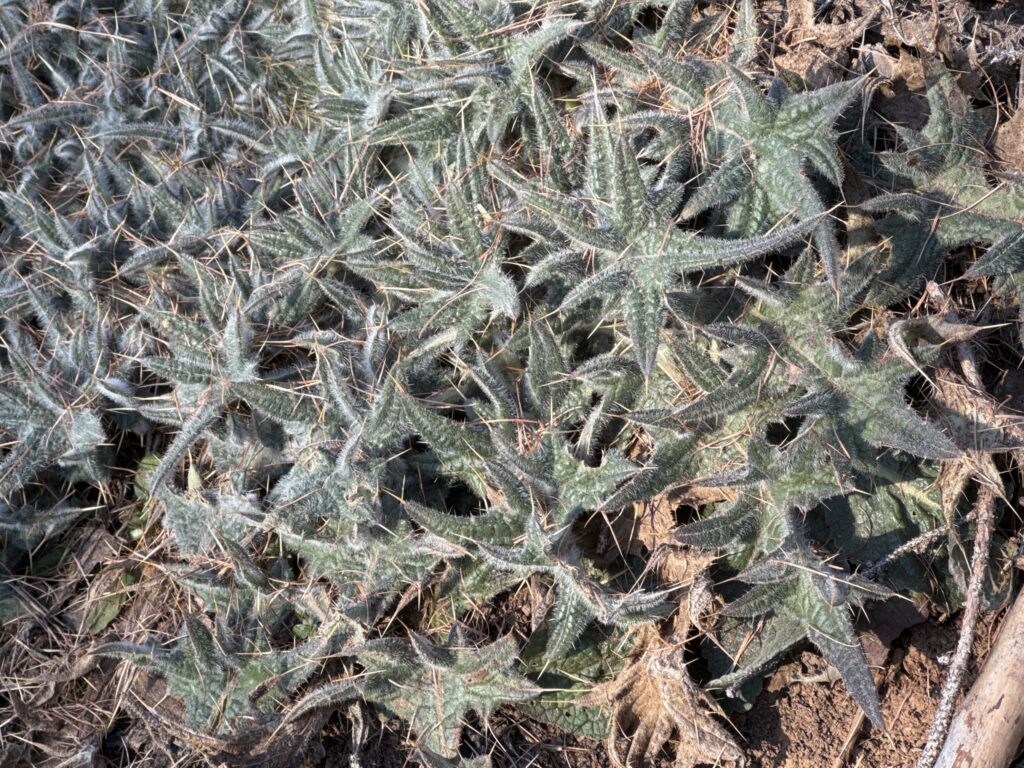
Bull Thistle is a biennial that has naturalized extensively throughout New England, establishing itself in fields, pastures, roadsides, and disturbed areas. It thrives in full sun to partial shade and tolerates poor soil quality, making it an aggressive colonizer of marginal land. The plant produces a deep taproot reaching 12-18 inches. In New England, plants germinate in late summer or fall, overwinter as rosettes, and bolt in their second year, flowering July through September. A single plant can produce tens of thousands of wind-dispersed seeds. While invasive in agricultural contexts, Bull Thistle establishes valuable habitat for native insects including specialist bee and butterfly pollinators.
Safety & Interactions
Bull Thistle is generally recognized as safe for consumption, with a long history of culinary use in Europe and Asia. No significant toxicity has been documented in human consumption. Some individuals may experience allergic reactions to Asteraceae family plants. The inulin content may cause gastrointestinal distension in individuals unaccustomed to high-fiber foods. Pregnant and nursing individuals can safely consume Bull Thistle in moderate amounts as a food. No significant drug interactions have been documented. Individuals with histamine sensitivity may wish to exercise caution. The bitter compounds may be problematic for individuals with ulcers or irritable bowel syndrome in acute phases.
New England Specific
Bull Thistle has become a defining feature of New England’s landscape, introduced in colonial times with agricultural seed stock. Over three centuries it has established itself so thoroughly that many contemporary residents consider it native. The plant’s relationship to New England’s agricultural history is profound: farmers have simultaneously cursed it as a persistent pest while utilizing its roots as an emergency food source. The thistledown is iconic imagery of New England autumn. For New England herbalists, Bull Thistle represents an opportunity to work with readily available local plants and to practice gratitude for food and medicine provided by plants established through human activity.
Pharmacological Actions: Anti-inflammatory, Antioxidant, Astringent, Diuretic
Traditional Herbalism Information
Parts Used & Their Applications
Bull Thistle root constitutes the primary plant part used in herbalism, valued for its inulin content and traditional classification as a bitter root tonic. The root is employed in decoctions and infusions to support digestive function, enhance hepatic secretion, and strengthen overall vitality. The aerial parts—leaves, stems, and flowers—are used as a bitter herb supporting digestive secretion and are traditionally classified as alterative agents. The seeds are used in traditional herbalism as a nutritive food and mild laxative. In European folk herbalism, Bull Thistle root was recognized as an edible root vegetable suitable for daily consumption, bridging the gap between food and medicine.
Preparation Methods
The most traditional preparation of Bull Thistle root is as a decoction, simmering cleaned and chopped root (fresh or dried) in water for 15-20 minutes, producing a mildly bitter, slightly sweet-tasting preparation. A long infusion (overnight steeping in hot water) extracts inulin and other water-soluble compounds. A cold infusion (room temperature water, 4-6 hours) produces a preparation with enhanced palatability and preserved enzyme content. Root tincture using standard ethanol extraction provides a convenient dosing method. The root can be roasted and used as a coffee substitute or dietary supplement, enhancing digestibility of the inulin. Aerial parts are best prepared as fresh herb infusion or short decoction (5-10 minutes maximum to preserve volatile compounds).
Traditional Applications
Bull Thistle’s primary traditional application is as a bitter root tonic employed to enhance digestive secretion and support hepatic function. In traditional European herbalism, it was prescribed for individuals with weak digestion characterized by poor nutrient absorption and sluggish bile production. The plant was used to support recovery from chronic illness, particularly when weakness and debility resulted from digestive insufficiency. Traditional herbals classify Bull Thistle as an alterative agent—a plant category intended to gradually and gently restore constitutional health over extended periods of use. The aerial parts were traditionally employed in poultices applied to wounds, cuts, and abrasions. Traditional practitioners employed Bull Thistle in the treatment of glandular swelling, particularly of lymph nodes and the liver.
Modern Adaptations
Contemporary herbalism has embraced Bull Thistle as a valuable plant in the bitters category, with practitioners preparing root extracts and herbal combinations to enhance digestive secretion before meals. Modern herbalists recognize the inulin content as valuable for prebiotic support of healthy gut microbiota, positioning Bull Thistle alongside Chicory and Jerusalem Artichoke. The plant is increasingly incorporated into digestive bitters formulas. Contemporary practitioners have renewed interest in Bull Thistle as an edible plant, reflecting broader movements toward wild food foraging and permaculture. Some modern practitioners have begun exploring Bull Thistle’s potential role in supporting healthy microbiota balance.
New England Specific
For New England practitioners, Bull Thistle represents an abundant local resource. The thistle’s presence in New England is now so complete that treating it as a native plant is almost justified by its ecological integration. New England herbalists can practice wildcrafting skills and sustainable harvesting of this prolific plant without concern about over-harvesting—instead, harvesting may constitute ecological management. Many New England herbalists are renewing knowledge of Bull Thistle as an edible root vegetable, connecting contemporary practice to 19th-century folk uses when the plant provided winter nutrition for rural communities.
Harvest Notes
Ethical harvesting should focus on populations that are actively problematic in agricultural or disturbed contexts. First-year roots in autumn are ideal, requiring only a spade to remove the long taproot intact. A single plant can yield 2-4 ounces of fresh root. Aerial parts can be harvested throughout the growing season by cutting above the lowest leaves. Gloves are absolutely essential when harvesting aerial parts. Seeds should be collected in late August through September as they begin to dry on the plant but before natural dispersal. The plant’s extreme prolific seeding means harvesting simultaneously contributes to population management.
Traditional Uses: Anti-inflammatory, Digestive Support, Liver Support, Tonic, Wound Healing
Magical Correspondences Information
Magical Correspondences
Bull Thistle carries powerful Mars correspondence, embodying the planet’s qualities of protection, boundaries, and martial strength. The plant’s formidable spines reflect Mars’s defensive energy and capacity to repel unwanted influence. The Fire element association is natural—the thistle’s spiky appearance, vibrant energy, and historical role in warfare charms all align with Fire’s transformative and protective qualities. Some traditions assign Jupiter correspondence to Bull Thistle, honoring its role as a bringer of abundance and its prolific seeding. The plant’s bitter taste corresponds to Fire element in alchemical taste theory.
Magical Intentions
Bull Thistle serves as a powerful ally in protective magic, particularly workings designed to establish firm boundaries and repel harmful influence or malevolent intent. The plant is employed in defensive workings intended to protect property, persons, or sacred space from unwanted intrusion. Practitioners use Bull Thistle in workings focused on courage, strength, and the capacity to stand firm in one’s convictions despite opposition. The plant supports magic designed to reverse harmful intention—the spines magically returning negativity to its source. In prosperity work, Bull Thistle is employed to ensure abundance accessible only to those with pure intention. The plant is used to strengthen will and determination, to support individuals in difficult transitions requiring courage and steadfastness.
Ritual Uses
Bull Thistle dried flowers and stems can be burned as a protection incense, with the smoke creating a boundary around sacred space or individuals requiring spiritual defense. The plant is placed around the edges of properties to create a spiritual boundary. Charm bags and protective poppets are created with dried Bull Thistle material. In circle casting for magical work focused on boundaries, courage, or Mars energy, fresh Bull Thistle stems (carefully handled) can be placed at cardinal points or woven into a protective wreath. The flower heads are collected and pressed into grimoires when writing spells related to protection or boundary-setting. The seeds are scattered around properties or in corners of homes requiring spiritual protection.
Color Correspondences
The purple-pink of Bull Thistle flowers aligns with Mars energy in its deeper, more saturated forms, and with Crown Chakra work and spiritual protection in lighter lavender tones. The green of the stems and leaves corresponds to money magic, abundance, healing, and growth. The gray-white of the flower bracts and thistle-down corresponds to clarity, truth-speaking, and clear vision that accompanies spiritual protection. The brown of dried roots corresponds to grounding, stability, and the earth element.
Sabbat Associations
Bull Thistle is most strongly associated with Lammas (Lughnasadh), the first harvest festival when the plant’s seed production peaks, connecting it to themes of generative abundance and the understanding that every ending contains seeds of new beginning. The plant is also relevant to Samhain, as its dried flower heads and down are iconic imagery of autumn’s transition. At Imbolc, dried Bull Thistle can be used in planning and intention-setting for the year ahead.
Traditional Lore & Folk Magic
Bull Thistle appears throughout European folk magic as a protector against malevolent witchcraft, with scattered thistle-down around a property creating a spiritual boundary against hexing. Some traditions hold that growing thistles intentionally in a garden protects the household from evil eye and ill-wishing. Scottish folk tradition particularly emphasizes thistle as a symbol of national identity and protection. Medieval magic practices employed thistles in workings designed to inflict harm upon those who would trespass or steal, with the understanding that the plant’s spines magically returned harm to its source. In cunning craft traditions, Bull Thistle appears in charms designed to tie troublemakers in knots. The thistledown, when blown as a carrier of wishes, is believed in many traditions to carry intention directly to the divine or helpful spirits.
Combining with Other Plants
Bull Thistle combines powerfully with other Mars-ruled protective plants such as Garlic, Ginger, and Hot Pepper, creating multi-layered protective blends. When combined with Jupiter-ruled plants such as Bay Laurel or Oak, Bull Thistle creates a blend supporting both protection and prosperity. In boundary-work, combining Bull Thistle with Saturn-ruled Comfrey or Mugwort creates a powerful trio addressing protection, grounding, and deep spiritual work. Pairing Bull Thistle with Rosemary (Solar) creates a blend combining the Sun’s clarity and courage with Mars’s protective boundary-setting. The plant works well in combination with Angelica Root in protective workings, and with thorny protective plants such as Rose stems or Hawthorn thorns.
Planetary Rulers: Mars
Magical Intentions: Courage, Hex Breaking, Protection, Purification, Strength
Elemental Associations: Fire
1 Grieve, M. (1971). A Modern Herbal. Dover Publications. 2 USDA PLANTS Database. National Plant Data Center, NRCS. Retrieved from plants.usda.gov. 3 Hoffmann, D. (2003). Medical Herbalism: The Science and Practice of Herbal Medicine. Healing Arts Press. 4 Blumenthal, M., Busse, W. R., Goldberg, A., et al. (Eds.). (2000). Herbal Medicine: Expanded Commission E Monographs. Integrative Medicine Communications. 5 Mills, S., & Bone, K. (2005). The Essential Guide to Herbal Safety. Elsevier Health Sciences.