Canada Mayflower
Basic Information
Scientific Name: Maianthemum canadense
Plant Family: Asparagaceae
Conservation / Invasive Status: Least Concern
Geographic Range: Circumboreal, Eastern North America, Northeast US, Northern New England
Safety Level: Generally Safe
Harvest Season: Spring, Summer
Parts Used: Berries, Leaves, Roots
Scientific & Botanical Information
Active Compounds
Canada Mayflower (Maianthemum canadense Desf.) contains steroidal saponins as its primary documented chemical constituent. These saponins are found throughout the plant but are concentrated in the rhizome and bulbil structures. The genus Maianthemum is characterized by these saponin compounds, which are recognized as bioactive molecules with potential physiological effects. The aerial parts contain polysaccharides and various glycosides. The berries, which appear red to black in mature form, contain pigment compounds including anthocyanins. The plant material is relatively rich in minerals including potassium, magnesium, and calcium. The saponins present in Canada Mayflower are structurally similar to those found in related Liliaceae and Asparagaceae family plants. However, detailed phytochemical analysis of the specific saponin compounds and their concentrations remains limited. The rhizome, being the underground storage organ, presumably contains the highest concentration of active compounds.
What Science Shows
Modern pharmacological research specifically on Maianthemum canadense is virtually nonexistent. The limited scientific literature consists primarily of ethnobotanical documentation of traditional uses rather than controlled pharmacological studies. Research on related Maianthemum species and on other Asparagaceae family plants suggests that saponins may possess diuretic, expectorant, and potentially anti-inflammatory properties, though no such research has been conducted on Canada Mayflower specifically. Some historical references to saponin-containing plants suggest potential immunostimulatory effects, but this remains unvalidated for Canada Mayflower. The steroidal saponin content makes the plant theoretically bioactive, but clinical validation of any effects in humans remains absent. No toxicological studies have characterized the safety profile of Canada Mayflower. This plant represents an important gap in North American ethnopharmacological research, with traditional use documentation existing but modern pharmacological validation completely absent.
Growing in New England
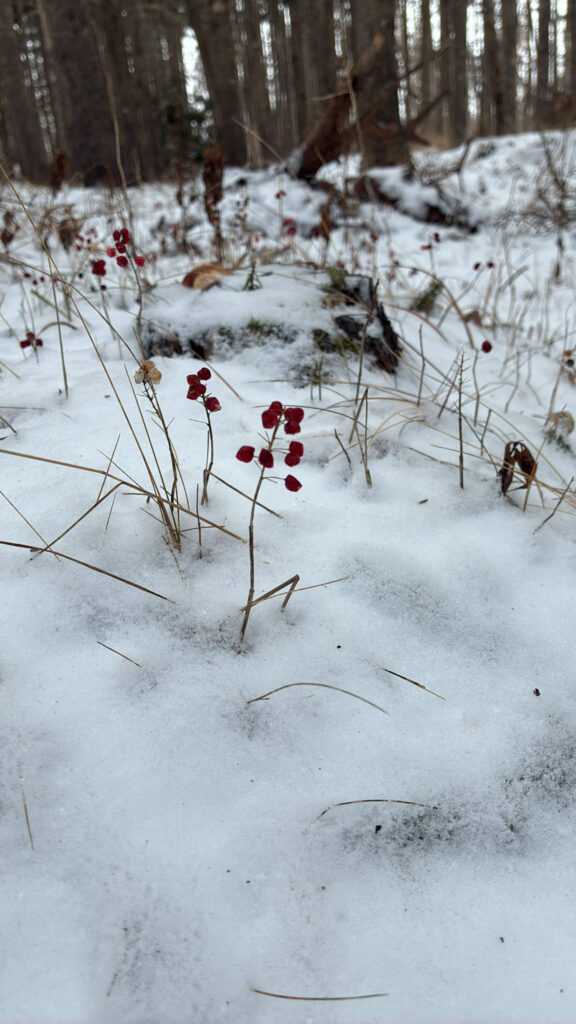
Canada Mayflower is a native New England perennial found abundantly in deciduous and mixed forests throughout the region. The plant grows from creeping rhizomes, forming extensive colonies in woodland understory settings. Canada Mayflower thrives in shade to partial shade conditions, preferring moist soils rich in organic matter. The plant is extremely shade-tolerant, often thriving in the dense shade beneath established tree canopy where few other herbaceous plants can survive. Growth is relatively slow but persistent, with established colonies potentially persisting for decades. The plant produces small white flowers in late spring (May-June), followed by red berries that mature to dark purple or black by late summer. These berries are attractive to forest birds and small mammals, which consume them and disperse seeds. Canada Mayflower’s ability to establish extensive ground-covering colonies makes it an important component of New England’s forest understory ecology. The plant’s presence often indicates mature, undisturbed forest habitat with adequate moisture and organic soil development.
Safety & Interactions
The steroidal saponin content of Canada Mayflower creates potential for significant toxicity if the plant is consumed. Saponins can damage cell membranes and may cause gastrointestinal irritation, hemolysis (rupture of red blood cells), and other serious effects if consumed in substantial quantities. Pregnant and nursing individuals should absolutely avoid Canada Mayflower due to the potential effects of saponins on fetal development and infant health. The plant should not be used internally without professional guidance from practitioners with extensive knowledge of saponin-containing plants. Skin contact with the plant material is generally safe, though some individuals may experience mild irritation. No drug interactions have been documented, primarily because controlled studies on Canada Mayflower are entirely absent. The berries, while attractive, should not be consumed due to their saponin content. This plant is best appreciated as an ecological component of forest ecosystems rather than as a material for internal consumption.
New England Specific
Canada Mayflower is abundant throughout New England, present in virtually every mature deciduous forest in the region. The plant’s presence is a reliable indicator of healthy forest ecosystems with adequate moisture and organic soil. Indigenous peoples of New England used Canada Mayflower traditionally, with ethnobotanical records documenting its use as a diuretic and tonic. For contemporary New England practitioners, Canada Mayflower represents an abundant local plant available for observation and study, though actual use remains constrained by safety concerns and limited documentation. The plant’s ecological role in supporting forest understory health and biodiversity makes it valuable from a conservation perspective. New England’s moist climate and abundant deciduous forests provide ideal conditions for Canada Mayflower’s flourishing.
Harvest Notes
Ethical harvesting of Canada Mayflower should be minimal due to the uncertainty regarding its safety profile and the limited documentation of appropriate dosing and preparation. In the rare circumstance of harvesting for research or educational purposes, aerial parts can be collected in late spring when flowers are present, or in autumn after berries mature. Rhizome harvest, which would damage the plant and impact its ability to regenerate, should be avoided. The plant’s superabundance in New England forests means that observation and non-extractive use remains more appropriate than harvesting. Seeds collected from mature berries and shared with native plant restoration projects contribute to the plant’s perpetuation without requiring harvest of living plant material.
Pharmacological Actions: Anti-inflammatory, Antioxidant, Diuretic, Mild cardiac glycoside activity, Tonic
Traditional Herbalism Information
Parts Used & Their Applications
Canada Mayflower was traditionally employed by indigenous peoples of the Northeast with a focus on the rhizome and aerial parts. The plant’s traditional classification as a diuretic and tonic herb suggests use in preparations designed to support fluid balance and overall vitality. Ethnobotanical records document traditional use as a diuretic tea, with the aerial parts steeped in hot water for medicinal purposes. Some records suggest traditional application of the plant material as a poultice for skin conditions and wounds. The berries, while attractive and potentially edible in small quantities without causing severe toxicity, were not emphasized in documented traditional uses. The rhizome, containing the highest concentration of active saponins, likely was the primary medicinal plant part in traditional indigenous practice. Modern documentation of specific traditional applications remains fragmentary and insufficient for establishing reliable usage protocols.
Preparation Methods
Traditional preparation of Canada Mayflower appears to have focused on aerial part infusion, created by steeping fresh or dried above-ground plant material in hot water to produce a mildly bitter tea. Decoction of the rhizome (if safely consumed at all) would follow standard protocols, though the safety of such preparations remains unvalidated. Tincture preparation using standard ethanol extraction could theoretically concentrate saponin compounds, though no established protocols exist. The saponin content might be reduced or eliminated through specific processing techniques (such as multiple decoctions with water removal), but no such traditional protocols have been documented for this species. Modern preparations of Canada Mayflower are rare to nonexistent, reflecting both the uncertainty regarding its safety profile and the limited documentation of effective preparation methods.
Traditional Applications
Canada Mayflower’s primary traditional application was as a diuretic, employed to support healthy fluid balance and urinary function. Some ethnobotanical records suggest traditional use as a general tonic, intended to gradually support overall constitutional health. The plant was traditionally used in the treatment of edema (excessive fluid retention), consistent with its diuretic classification. Traditional application in poultice form for wounds and skin conditions appears in some ethnobotanical records, suggesting anti-inflammatory or astringent effects, though these properties remain unvalidated. The plant appears to have been used as a supportive herb in recovery from illness, consistent with traditional tonic classification. Traditional indigenous applications emphasize the plant’s gentle, gradual effects rather than acute therapeutic action, suggesting use as a long-term supportive remedy.
Modern Adaptations
Contemporary herbalism has largely abandoned Canada Mayflower due to the absence of modern pharmacological validation and the uncertainty regarding its safety profile, particularly the potential toxicity of saponin compounds when consumed in inappropriate amounts. Some contemporary practitioners have renewed interest in the plant from an ethnobotanical perspective, seeking to document and preserve traditional knowledge of North American indigenous plants. A few contemporary herbalists working specifically with saponin-containing plants have begun cautious exploration of Canada Mayflower, though the lack of modern clinical documentation makes such work highly experimental and potentially risky. Modern herbalists recognize that the plant’s ecological abundance and lack of conservation concerns make it a lower priority for preservation than rarer species, allowing for a focus on protection rather than use.
New England Specific
For New England practitioners, Canada Mayflower represents an abundant local plant whose traditional knowledge is worth understanding and preserving even when direct medicinal use is constrained by safety concerns. The plant’s presence in virtually every mature New England forest makes it accessible for observation and study. Contemporary New England herbalists can practice forest ecology observation through attention to Canada Mayflower’s role in woodland understory communities, its relationship with forest birds and small mammals, and its role as an indicator of forest health. The plant’s traditional use by indigenous peoples of the region connects contemporary practice to ancestral knowledge and to the land itself. New England’s ideal conditions for Canada Mayflower growth make the plant a symbol of the region’s ecological abundance.
Harvest Notes
Given the uncertainty regarding safety protocols for Canada Mayflower consumption, harvesting for traditional medicinal use is not recommended. If future research validates traditional uses and establishes safe dosing protocols, aerial parts could be harvested in late spring at flowering time or in autumn, with the plant allowed to regenerate from its rhizomatous system. Rhizome harvesting, which would damage plant populations, should be avoided. Seed collection from mature berries provides a non-extractive way to contribute to the plant’s propagation and to native plant restoration projects. Documentation of local populations and their ecological roles provides valuable information without requiring any material harvest.
Traditional Uses: Diuretic, Headache Relief, Kidney Support, Sore Throat, Tonic
Magical Correspondences Information
Magical Correspondences
Canada Mayflower carries Moon correspondence, reflecting the planet’s association with water, fluidity, intuition, and gentle cyclical change. The plant’s association with moisture-loving habitats and its traditional use as a diuretic both reinforce the Water element association. Some traditions assign the plant to Venus, honoring the delicate white flowers and the gentle nature of the plant’s growth. The plant’s presence in the forest understory, in shadow and partial darkness, suggests correspondence to Saturn and to the mysteries hidden in shade. The creeping rhizomatous growth pattern suggests Mercury correspondence, reflecting the plant’s lateral, communicative movement through soil. The plant’s relationship to forest birds and small mammals suggests correspondence to Mercury (communication and connection) and to animal spirits and familiars.
Magical Intentions
Canada Mayflower serves as an ally in workings focused on gentle flow and the allowance of natural processes to unfold. The plant supports magic designed to reduce emotional overwhelm and to create space for clarity within confusion. Practitioners employ Canada Mayflower in workings focused on fluid communication and the free expression of emotional truth. The plant is used to strengthen intuition and to support connection with the subtle realms accessed through dreams and meditation. In water element magic, Canada Mayflower anchors intention around the themes of emotional depth, psychological fluidity, and the movement of energy through previously blocked channels. The plant supports work focused on forest connection and communication with the spirits of woodland ecosystems. In work focused on grief processing and emotional release, Canada Mayflower facilitates the gentle tears and emotional expression that allow healing.
Ritual Uses
Fresh Canada Mayflower flowers and aerial parts can be placed on altars dedicated to water, the Moon, or to emotional healing and intuitive development. The plant is used in rituals conducted in forest settings, grounding practitioners in woodland energy and forest consciousness. Dried aerial parts can be burned as incense in rituals focused on gentle clearing and emotional release. The berries can be collected (leaving the majority for birds and mammals) and placed on altars dedicated to abundance and the generative power of forest ecosystems. In circle casting for work related to water, emotion, and intuition, Canada Mayflower can mark cardinal points or create altar focus. The plant’s creeping growth pattern can inspire ritual movement—walking slowly and deliberately through the forest while maintaining attention to the understory where Canada Mayflower thrives.
Color Correspondences
The white of Canada Mayflower flowers corresponds to purity, clarity, spiritual insight, and fresh beginnings. The green of the heart-shaped leaves corresponds to growth, abundance, and vitality. The red berries maturing to dark purple or black correspond to the depth of emotion, to the transition from brightness to mystery, and to the ripening of inner knowledge. The overall appearance of the plant—delicate, small-scaled, thriving in shadow—corresponds to the subtle, the hidden, and the power found in things that appear fragile but are actually remarkably persistent.
Sabbat Associations
Canada Mayflower’s spring flowering and red to dark berry production make it most strongly associated with Beltane, the festival marking the transition from spring to summer and the movement of energy toward abundance. The plant is also relevant to Lughnasadh (Lammas) when berries ripen and the first harvest begins. The dark berries connect the plant to Samhain and autumn’s descent into darkness. The plant’s evergreen presence in the forest understory (with leaves persisting through New England winters in protected locations) makes it relevant to Imbolc, when life begins to stir beneath the snow. At Midsummer, the plant’s shadowy location contrasts with the bright sunlit upper forest, creating complementary magical energy.
Traditional Lore & Folk Magic
Canada Mayflower carries significance in contemporary North American witchcraft as a symbol of the subtle, the hidden, and the power of things that work beneath notice. The plant’s creeping rhizomatous spread makes it a symbol in workings focused on gradual change and the movement of energy through previously blocked spaces. In some traditions, mayflowers are associated with the arrival of spring and with hope and renewal—associations Canada Mayflower shares despite its woodland rather than meadow habitat. The plant’s support for birds and small mammals in forest ecosystems makes it a symbol in contemporary nature-honoring and ecological witchcraft traditions. The plant’s traditional use by indigenous peoples of North America connects it to the deep history of the land and to the necessity of respecting plant knowledge across cultures.
Combining with Other Plants
Canada Mayflower combines beautifully with other Moon-ruled plants such as Mugwort or Evening Primrose, creating intention around intuition and emotional clarity. In water element magic, the plant pairs well with other water plants such as Water Lily or with other moisture-loving plants. When working with forest energy, Canada Mayflower combines well with other woodland plants such as Trillium or Lily-of-the-Valley, creating powerful intention around forest consciousness and woodland restoration. In emotional healing work, Canada Mayflower combines with Rose petals or Jasmine flowers to create gentle intention around emotional release and the softening of hardened emotional patterns. The plant works well in combination with other plants that spread underground, creating shared intention around gradual, persistent change. Canada Mayflower can be combined with Iris Root in magical work focused on bridging the conscious and unconscious realms.
Planetary Rulers: Mercury, Moon
Magical Intentions: Clarity, Communication, Healing, Protection, Spring Magic
Elemental Associations: Air, Water
1 Moerman, D. E. (1998). Native American Ethnobotany. Timber Press. 2 USDA PLANTS Database. National Plant Data Center, NRCS. Retrieved from plants.usda.gov. 3 Hoffmann, D. (2003). Medical Herbalism: The Science and Practice of Herbal Medicine. Healing Arts Press. 4 Mills, S., & Bone, K. (2005). The Essential Guide to Herbal Safety. Elsevier Health Sciences.