Common Hawthorn
Basic Information
Scientific Name: Crataegus monogyna
Plant Family: Rosaceae
Conservation / Invasive Status: Least Concern
Geographic Range: Introduced/Naturalized in Northern New England
Safety Level: Generally Safe
Harvest Season: Autumn (berries), Spring (flowers)
Parts Used: Berries, Flowers, Leaves
Scientific & Botanical Information
Active Compounds
Common hawthorn contains well-characterized oligomeric proanthocyanidins (OPCs), flavonoids (vitexin, hyperoside, quercetin), and organic acids. Standardized extracts typically quantify these constituents as the basis for clinical efficacy claims.1,2
What Science Shows
Extensive clinical research demonstrates positive inotropic effects (increased cardiac contractility), antiarrhythmic properties, and improved coronary blood flow. Multiple randomized controlled trials show benefit in heart failure (NYHA stage II-III) and improved exercise tolerance.1,3,4 Flavonoid content contributes vasodilatory and antioxidant mechanisms. The phytopharmacology is well-established in European phytomedicine literature.2
Growing in New England
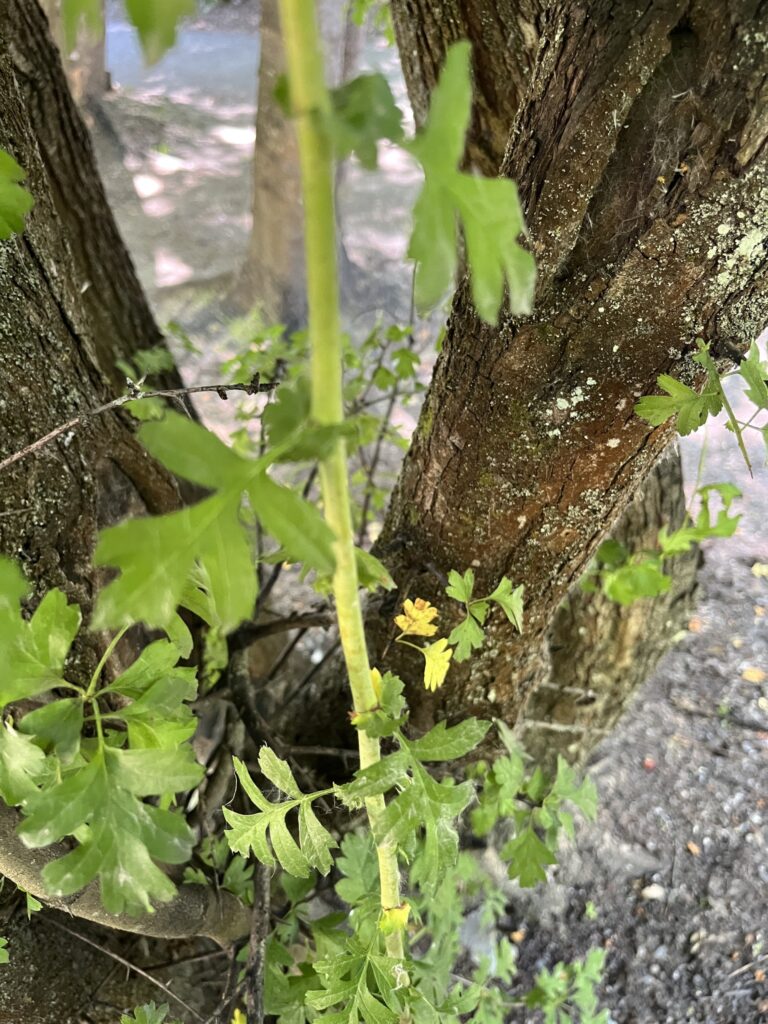
Crataegus monogyna is naturalized throughout New England, preferring full sun and well-drained soils. Hardy to zone 4. Tolerates poor soil and drought once established. Flowers May–June; fruits ripen September–October. May be confused with native Crataegus species (C. punctata, C. oxycantha).
Safety & Interactions
Generally well-tolerated. May potentiate cardiac glycosides (digoxin); use with caution. No major toxicity reported. Mild gastrointestinal effects possible at high doses.1
New England Specific
Widely cultivated as ornamental; naturalized in old fields and roadsides. Historic use in European herbalism; adopted into American practice by 20th century.
Pharmacological Actions: Antioxidant, Cardiotonic, Hypotensive, Positive inotropic effect, Stress-reducing, Vasodilatory
Traditional Herbalism Information
Parts Used & Their Applications
Leaf and flower (used fresh or dried); fruit (hawthorn berries) used for decoctions and tinctures. Leaf-flower preparation traditionally considered most potent for cardiovascular support. Berries traditionally used for digestive properties and cardiovascular tonics.
Preparation Methods
Infusion: 1–2 tsp dried leaf-flower per cup hot water, 10 min steep, 2–3× daily. Tincture (1:5, 40% alcohol): 1–2 mL thrice daily. Standardized extracts dosed per product specification (typically 160–180 mg flavonoid glycosides daily in clinical trials).
Traditional Applications
Traditionally prescribed for heart palpitations, anxiety, and ‘weak heart.’ Used in European folk herbalism for centuries. Victorian herbalists recommended for both prevention and symptom management of cardiovascular complaints.
Modern Adaptations
Contemporary herbalists combine hawthorn with other cardiovascular herbs (motherwort, linden) in heart support formulas. Often recommended as preventive tonic for those with family history of cardiac disease. Adapts well to herbal supplement and tea market.
New England Specific
Native hawthorn species (C. punctata, C. macracantha) have similar traditional uses; however, C. monogyna is the most clinically researched. Both native and introduced species were used by settlers adapted to existing Crataegus knowledge.
Harvest Notes
Leaf and flowers harvested May–June at peak bloom. Berries collected September–October when deep red. Dry quickly to preserve color and potency. Properly dried material maintains activity for 1–2 years in cool, dark storage.
Traditional Uses: Angina relief, Anxiety and nervousness, Cardiac recovery following myocardial events, Heart and circulatory support, Heart palpitations, Hypertension management
Magical Correspondences Information
Magical Correspondences
Planetary: Mars (strength, protection, courage). Element: Fire. Sacred in Celtic tradition; associated with Beltane and Samhain festivals. Known as Whitethorn in British folk magic.
Magical Intentions
Heart opening and protection; courage; boundary setting; purification; ancestral connection. Used to strengthen will and resolve.
Ritual Uses
Hawthorn branches hung above doorways for home protection. Flowers used in Beltane fires and spring fertility rites. Berries incorporated into autumn protection sachets. Thorns traditionally used in poppet magic for binding and protection.
Color Correspondences
White flowers (purity, protection, new beginnings); red berries (passion, strength, vitality); dark green foliage (grounding, stability).
Sabbat Associations
Beltane (fire festival, May 1); Samhain (ancestor connection, protective threshold). May Day traditions strongly associated with hawthorn blossoms.
Traditional Lore & Folk Magic
In British and European folklore, hawthorn is simultaneously protective and liminal—associated with fairy realms and boundary spaces. Cutting hawthorn without permission brings bad luck. Trees protected by law in some traditions. The ‘Holy Thorn’ of Glastonbury is hawthorn lore deeply embedded in Arthurian mythology.
Combining with Other Plants
Rose (heart-centered love magic); motherwort (emotional protection); St. John’s wort (light, purification); rowan (protective boundary magic).
Planetary Rulers: Sun
Magical Intentions: Fertility, Happiness, Hope, Love, Protection, Purification
Elemental Associations: Fire
1 Pittler MH, Guo R, Bösch H. (2008). Hawthorn extract for heart failure. Cochrane Database Syst Rev. 1:CD000519.
2 Holubarsch CJF, Colucci WS, Meinertz T. (2008). The efficacy and safety of Crataegus extract WS 1442 in patients with heart failure. Eur J Heart Fail. 10(12):1255-1263.
3 Weihmayr T, Krieglstein J. (1996). Proof of efficacy of Crataegus extract WS 1442 in patients with nonobstructive HOCM. Phytomedicine. 3(1):48-52.
4 Blumenthal M (ed). (2003). The ABC Clinical Guide to Herbs. American Botanical Council.