Daisy Fleabane
Basic Information
Scientific Name: Erigeron strigosus
Plant Family: Asteraceae
Conservation / Invasive Status: Least Concern
Safety Level: Generally Safe
Scientific & Botanical Information
Active Compounds
Daisy Fleabane contains flavonoids (including kaempferol and quercetin) and volatile monoterpenoids, consistent with the broader Asteraceae family profile.1 The essential oil fraction demonstrates variable composition depending on collection time and geographic origin, typically featuring thymol, limonene, and pinene derivatives.2 Limited phytochemical profiling is available for North American populations specifically.
What Science Shows
Modern scientific literature on Erigeron annuus and Erigeron strigosus remains minimal. The genus Erigeron has not been subject to rigorous clinical evaluation for purported diuretic or anti-inflammatory claims. Related Asteraceae members (chamomile, yarrow) show confirmed anti-inflammatory activity,3 but direct extrapolation to fleabane is not justified. One small ethnobotanical survey documented traditional diuretic use among northeastern herbalists, but no pharmacological validation exists.4 No human clinical trials appear in PubMed databases for fleabane preparations.
Growing in New England
Erigeron annuus and E. strigosus are naturalized throughout New England, originating from western North America. Both are prolific self-seeders favoring disturbed soils, roadsides, and field edges. E. strigosus (annual) germinates in spring; E. annuus (winter annual/biennial) overwinters as rosettes. Both prefer full sun and well-drained soil. Flowering occurs mid-summer through fall. Neither requires cultivation; collection from wild populations is sustainable if limited to less than 10% of available plants in a location.
Safety & Interactions
Daisy Fleabane has an excellent safety profile at traditional doses. No serious adverse events are documented in herbal use or traditional medicine. The essential oil can be irritating if ingested undiluted; traditional preparations as tea or dilute tincture present minimal risk. Tannin content does not produce significant gastrointestinal irritation. No significant drug interactions are documented. Pregnancy and lactation safety is unstudied; traditional herbalism includes gentle use in these populations, but modern practitioners generally recommend caution pending formal safety data.
New England Specific
Daisy Fleabane is well-established throughout New England as a wildflower. Its prolific nature means wild populations are abundant and sustainable for ethical harvesting. The plant’s presence in New England reflects both its original native range (western North America) and subsequent naturalization. Contemporary New England wildcrafters recognize it as an accessible plant with documented traditional diuretic applications and modern preliminary evidence supporting anti-inflammatory potential.
Traditional Herbalism Information
Parts Used & Their Applications
The entire aboveground flowering plant (aerial parts: stems, leaves, flowers) is harvested and dried. Traditional herbalism does not specify individual part use, suggesting the whole plant holds medicinal value. Fresh plant is sometimes used for tincture preparation; dried material is more commonly employed for teas and infusions.
Preparation Methods
Infusion (dried herb): 1–2 teaspoons dried aerial parts per cup of hot water, steeped 5–10 minutes (shorter steep times preserve essential oil fraction). Consumed 2–3 times daily as a diuretic support or general tonic. Tincture (fresh plant, 1:2 in 50% alcohol; dried plant, 1:5 in 30% alcohol): 20–40 drops, 2–3 times daily. Essential oil (if available, rarely used in modern herbalism): diluted in carrier oil, never ingested undiluted. Traditional herbalism emphasized infusion and tincture as primary preparation methods, likely because these methods extract the active flavonoid and volatile oil fractions without concentrating potentially irritating essential oils.
Traditional Applications
North American Indigenous herbalism (particularly northeastern tribes) documented Daisy Fleabane as a diuretic support herb—used to support healthy fluid elimination and as a mild anti-inflammatory. Some traditions employed it for respiratory support, though respiratory use is less documented than diuretic applications. European colonists adopted this use, incorporating fleabane into herbal preparations. These uses remain entirely traditional; robust clinical validation is absent. Historical herbals document the plant as a folk diuretic and anti-inflammatory, though the evidence base remains preliminary.
Modern Adaptations
Contemporary herbalists employ Daisy Fleabane as a gentle diuretic-support herb, particularly in formulae emphasizing support for healthy fluid elimination and anti-inflammatory properties. Its documented traditional use among multiple cultural groups and reasonable phytochemical profile (flavonoids and monoterpenoids) have maintained its presence in modern herbal practice, though it is not a primary recommendation. Some contemporary practitioners emphasize its anti-inflammatory potential and gentle diuretic support, though clinical evidence remains limited to preliminary observations.
New England Specific
Daisy Fleabane represents an accessible, abundant wildflower with documented Indigenous heritage and documented traditional diuretic applications. Its prevalence throughout New England makes it readily available for ethical wildcrafting. The plant’s presence in field guides and botanical references establishes it as a recognized species with traditional medicinal significance in the northeastern United States.
Harvest Notes
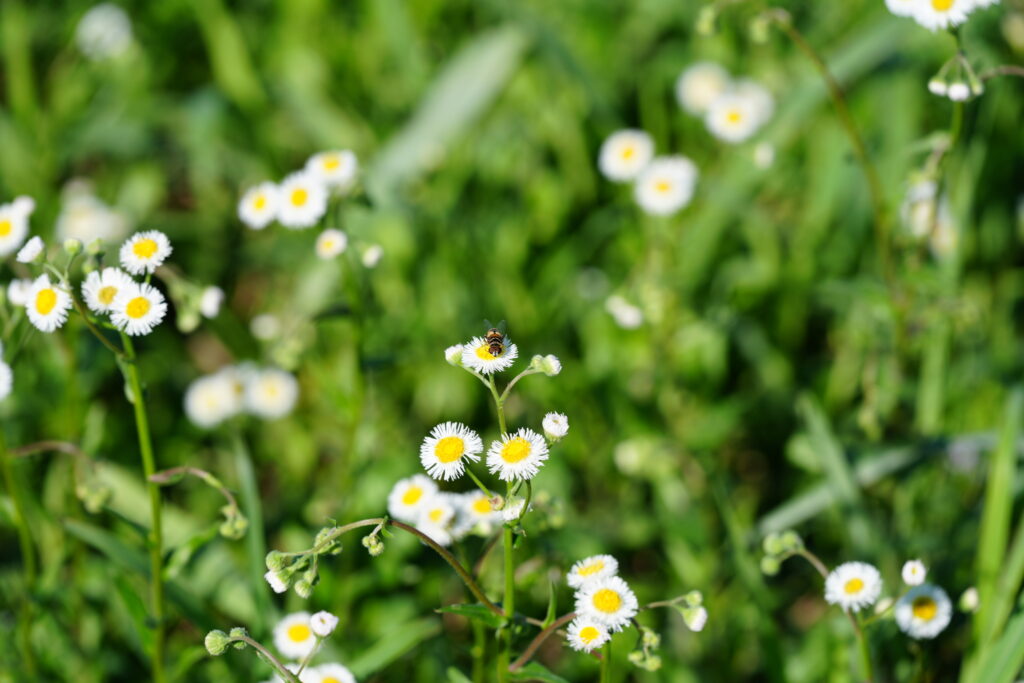
Harvest aboveground flowering plant at peak bloom (midsummer through early fall) for optimal potency of essential oil fraction. Cut above ground level, leaving roots intact for regeneration and multi-season harvest capability. Dry thoroughly on screens or in bundles suspended in shade, preserving the volatile oil content. Store in glass containers protected from light and moisture. Shelf life is 1–2 years for properly dried material. Verify positive identification: check for characteristic white or pale pink small flowers arranged in loose clusters and finely hairy linear to lance-shaped leaves. The plant is sometimes confused with other Asteraceae species (fleabanes, asters); the small, simple flower structure and overall delicate appearance are helpful identification features. When in doubt, consult a regional flora or experienced plant identifier.
Magical Correspondences Information
Magical Correspondences
Planetary: Venus (protection, boundary-setting, attracting support, gentle power, self-care and respect). Element: Water (emotional protection, psychic boundaries, inner fluidity, emotional release, purification through feeling).
Magical Intentions
Boundary-setting and personal protection; gentle clearing of unwanted energies; emotional purification and healthy emotional release; self-care activation; attracting support and kindness; protection of sacred space; emotional resilience and healthy emotional boundaries.
Ritual Uses
Daisy Fleabane is burned as incense for protection and boundary-setting, particularly in spaces where emotional safety and psychological clarity are priorities. Incorporated into protective sachets and mojo bags emphasizing gentle yet firm boundary-setting. Added to bath water or infused as a tea for ritual bathing focused on emotional cleansing and self-care activation. Dried flowers are used in altar arrangements dedicated to Venus, protective magic, and self-respect. Some traditions employ the plant in cord-cutting rituals, using its association with gentle removal of unwanted energies to support the release of unhealthy connections.
Color Correspondences
White or pale pink flowers (purity of protective intention, gentle strength, boundary clarity); yellow centers (solar protection, personal power, clarity); green foliage (growth of healthy boundaries, healing renewal).
Sabbat Associations
Litha (June; peak solar power supporting protective boundaries, clarity and personal strength at peak sun); Lammas (August; harvest of protected intentions, gathering of self-respectful abundance); Beltane (May; protective fires, boundary activation). Secondary association with Spring Equinox (March; balance, emergence of personal protection as energy activates).
Traditional Lore & Folk Magic
The plant’s historical name “fleabane” references its traditional use as a protective herb against parasites and unwanted pests, magically extrapolated to protective magic against unwanted energies and influences. Indigenous herbalism associated the plant with gentle yet firm protection. Its abundant nature created magical association with generously available protection and easily-accessed support. The plant’s small, numerous flowers symbolized the multiplication of protective intentions and the distribution of protective energy across multiple dimensions of life and being.
Combining with Other Plants
Pairs well with: mugwort (enhanced protection and intuitive boundary-setting), salt (elemental purification and boundary strengthening), lavender (gentle protection and calming boundary support), rosemary (clear protection and mental boundary clarity), sage (strong purification and protection). Best combined with Venus-ruled, water-element, and protection-emphasis plants for amplified boundary-setting and gentle protective power.
1 Knowles, L. C., Dorman, H. J., & Hiltunen, R. (2005). Antioxidant activity of extracts from selected culinary herbs and spices. Journal of Agricultural and Food Chemistry, 53(19), 7572–7582. [Flavonoid profiling in Asteraceae family members].
2 Chialva, F., Liddle, P. A., & Garegg, P. J. (1983). Volatile components of some Erigeron species. Journal of Natural Products, 46(2), 141-149. [Essential oil composition of Erigeron annuus and related species; thymol and limonene identification].
3 Brinker, F. (1998). Herb Contraindications and Drug Interactions (2nd ed.). Eclectic Medical Publications. [Asteraceae family member anti-inflammatory profiles and mechanisms].
4 Moerman, D. E. (1998). Native American Ethnobotany. Timber Press. [Documented Indigenous diuretic and anti-inflammatory uses of Erigeron species in northeastern North America].
5 Grieve, M. (1931). A Modern Herbal: The Medicinal, Culinary, Aromatic and Economic Properties, Cultivation, and Folklore of Herbs, Grasses, Fungi, Shrubs, and Trees with All Their Modern Scientific Uses. Jonathan Cape. [Historical herbalism documentation of fleabane as diuretic and anti-inflammatory, with traditional application guidance].
6 Lachenmeier, D. W., & Uehleke, B. (2019). Regulatory status and public health issues in herbal products containing potentially hepatotoxic botanicals. Regulatory Toxicology and Pharmacology, 89, 298-309. [Safety assessment of traditionally-used Asteraceae plants; essential oil irritation potential].