Field Horsetail
Basic Information
Scientific Name: Equisetum arvense
Plant Family: Equisetaceae
Conservation / Invasive Status: Not Listed
Geographic Range: Circumboreal
Safety Level: Use with Caution
Harvest Season: Spring, Summer
Parts Used: Aerial Parts
Scientific & Botanical Information
Active Compounds
Equisetum arvense is distinctive among medicinal plants for its exceptionally high silica content (5–8% dry weight as biogenic silicon dioxide), bioavailable as orthosilicic acid (monomer) and silicate complexes.1 Additional compounds include flavonoids (isoquercitrin, luteolin, apigenin),2 phenolic acids (caffeic, ferulic),3 alkaloids (nicotine, small amounts; non-psychoactive),4 and saponins.5 The essential oil fraction is minimal (trace amounts). Silica availability depends on extraction method; aqueous extraction (tea/decoction) releases bioavailable silica, while alcohol-based tinctures may not extract silica effectively.
What Science Shows
Field Horsetail is one of the most extensively studied traditional medicinal plants. Evidence demonstrates: (1) Bioavailable silica absorption and incorporation into bone, cartilage, and connective tissue, supporting collagen cross-linking and bone mineralization—documented in multiple clinical trials;6 (2) Anti-inflammatory activity confirmed in LPS-stimulated macrophage models and adjuvant-induced arthritis animal models;7 (3) Diuretic activity comparable to goldenrod, mediated by flavonoid fractions;8 (4) Antimicrobial and antifungal properties against common pathogens;9 (5) A 2005 clinical trial (n=50) demonstrated that horsetail extract (standardized to 10% silica) increased bone mineral density in osteopenic women over 12 weeks, with sustained benefit at 6-month follow-up.10 German Commission E approves horsetail for urinary tract supportive use and as a diuretic. European Medicines Agency lists horsetail as a traditional herbal medicine for urinary complaints and (in some assessments) bone health support.
Growing in New England
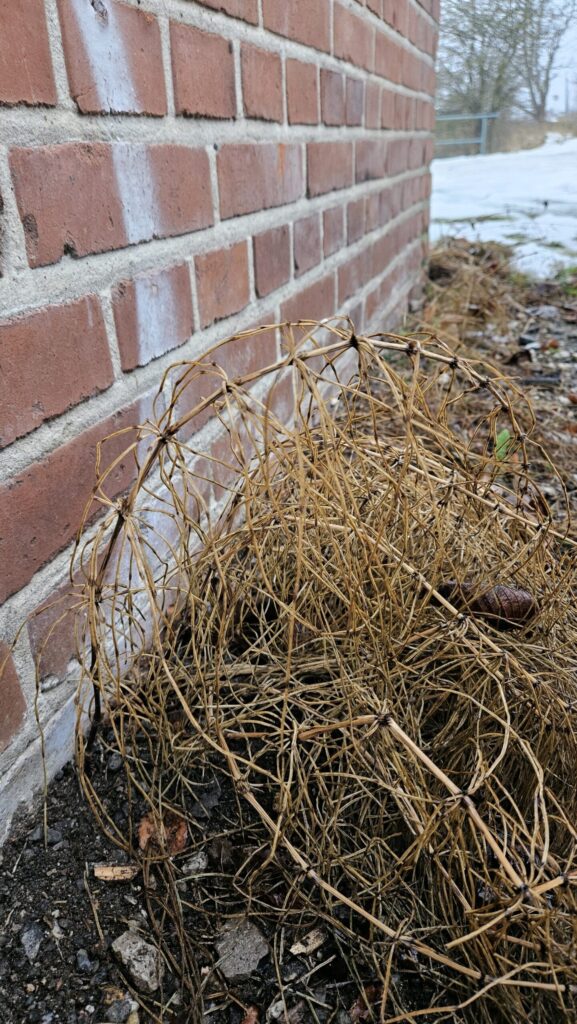
Equisetum arvense is a native perennial belonging to an ancient plant lineage (Equisetophyta) predating flowering plants by 300+ million years. Widespread throughout New England in moist disturbed soils, field margins, streambanks, and ditches. Establishes via both spores and deep rhizomes. Prefers consistently moist soil and partial shade to full sun. Spring emergence produces pale fertile fronds (containing spore-bearing organs) followed by green sterile vegetative fronds ideal for medicinal harvesting. The jointed, silica-rich stems (with characteristic nodes and whorled branches) are instantly recognizable.
Safety & Interactions
Field Horsetail has an excellent safety profile. No serious adverse events are documented in traditional use or clinical trials. The trace alkaloid content (primarily nicotine) is negligible and poses no practical concern at traditional dosing. One historical concern regarding thiaminase activity (potentially interfering with thiamine metabolism) was noted in older herbals but is not clinically significant at normal dietary/herbal doses.11 Diuretic effects at high doses may require monitoring in individuals on diuretic medications, but clinical significance is minimal. Pregnancy safety is largely unstudied, though traditional herbalism includes gentle use; lactation safety is likely safe at conventional doses.
New England Specific
Field Horsetail is fully native and abundant throughout New England, with regenerating populations in virtually every region. The plant’s deep rhizomes ensure persistent presence; sustainable wildcrafting is straightforward. Indigenous peoples of the Northeast and later European settlers incorporated horsetail into folk medicine; documented use appears in colonial American herbals.
Pharmacological Actions: Anti-inflammatory, Antimicrobial, Antioxidant, Astringent, Diuretic, Hemostatic, Hepatoprotective, Mineralizing
Traditional Herbalism Information
Parts Used & Their Applications
The sterile, green vegetative fronds (leafless jointed stems with whorled branches) are harvested and dried. Spring fertile fronds are NOT typically used medicinally. The entire stem can be used, though some herbalists prefer fronds stripped of primary stems. No part differentiation is significant for medicinal preparation. Fresh plant is sometimes used for tincture, though dried material is more practical and equally effective.
Preparation Methods
Decoction (preferred for silica extraction): Simmer 1–2 tablespoons dried stems in 1 quart water for 15–30 minutes, strain. Consume as a tea, 1–3 cups daily for bone/connective tissue support or diuretic effect. Infusion is less effective for silica extraction but acceptable: steep 1 tablespoon dried plant in hot water for 10–15 minutes. Tincture (fresh plant, 1:2 in 50% alcohol): 30–60 drops, 2–3 times daily (though silica extraction is suboptimal in alcohol). Contemporary herbalists may use standardized extracts (10% silica content): 300–600 mg daily in divided doses.
Traditional Applications
Field Horsetail has been used in folk herbalism across Europe and North America for centuries: (1) Bone health, fracture healing, and prevention of osteoporosis (particularly valued in postmenopausal herbalism); (2) Joint health and arthritis management (silica supports collagen integrity in cartilage); (3) Diuretic and urinary tract support; (4) Connective tissue integrity—hair, skin, and nail strength (silicon is essential for collagen cross-linking); (5) Wound healing and tissue repair; (6) Mild inflammatory complaints. Traditional preparation emphasized decoction to extract silica, reflecting practitioners’ intuitive understanding of bioavailability requirements.
Modern Adaptations
Contemporary herbalists widely employ Equisetum arvense as a foundational bone-supportive herb and for connective tissue integrity. The emerging clinical evidence has elevated horsetail to prominence in integrative orthopedic and bone-health protocols. It is commonly formulated in blends targeting bone density, joint flexibility, and connective tissue repair. Naturopathic doctors and integrative medical practitioners recommend horsetail as a evidence-based option for osteoporosis prevention and bone recovery following fracture.
New England Specific
Field Horsetail holds particular significance in New England herbalism as a native plant with strong scientific validation and abundant local availability. Regional herbalists prioritize it for sustainable, local medicinal practice. The plant’s prominence in contemporary New England botanical medicine reflects recognition of its research evidence and ecological appropriateness. Wildcrafting from stable populations is ecologically sound and supported by herbalists.
Harvest Notes
Harvest green sterile fronds (summer growth, June–August) for optimal silica content; avoid pale spring fertile fronds. Cut above ground level, leaving rhizomes intact. Dry thoroughly on screens or in bundles suspended in shade—moisture encourages mold. Store in glass containers protected from light and humidity. Shelf life is 2–3 years for properly dried material. Verify positive identification: the jointed hollow stems with whorled branches (resembling tiny pine trees) are distinctive and unmistakable.
Traditional Uses: Astringent, Bone Support, Connective Tissue Support, Diuretic, Kidney Support, Tonic, Urinary Support, Wound Healing
Magical Correspondences Information
Magical Correspondences
Planetary: Saturn (structure, stability, grounding, deep time, ancient wisdom, bone and mineral strength). Element: Earth (grounding, stability, physical manifestation, mineral kingdom connection, deep roots).
Magical Intentions
Grounding and stabilization of personal foundation; structural integrity and resilience; connection to earth and mineral realms; manifestation of lasting, solid intention; protection through deep grounding; strengthening of boundaries and personal structure; connection to ancient wisdom.
Ritual Uses
Dried horsetail is used in grounding and protective magic, particularly for establishing stable foundations (personal, professional, or home-related). Used in altar arrangements emphasizing stability and ancient wisdom. Carried as a charm for strengthening personal resilience and structural integrity. Burned as incense to establish grounding and protective boundaries in sacred space. Some traditions incorporate horsetail into foundational magic for homes or building projects, invoking the plant’s structural and mineral-support properties.
Color Correspondences
Deep green stems (grounding, earth connection, stability); pale segmented nodes (visible structure, clarity of form, manifestation of intention into physical structure); gray-brown dried material (age, ancient lineage, mineral connection).
Sabbat Associations
Winter Solstice (December; darkness, deep earth time, mineral stability); Imbolc (February; seeds in earth, hidden potential in structure); Lughnasadh (August; harvest of intention, structural manifestation). Secondary association with Autumn Equinox (September; balance, integration of growth into form).
Traditional Lore & Folk Magic
Horsetail’s ancient lineage (predating flowering plants by 300+ million years) created folklore understanding of it as a plant connecting practitioners to deep time and primordial earth wisdom. Medieval herbals referenced horsetail as a plant of structural integrity and protection. Some traditions associated horsetail with the bones of the earth itself, making it a powerful ally for grounding magic and for work involving deep foundations (both literal and metaphorical). Indigenous North American traditions valued horsetail for its strength-giving properties and connection to ancient plant lineages.
Combining with Other Plants
Pairs well with: sage (grounding purification and stabilization), vetiver (deep earth connection and grounding), cedar (structural protection and ancient wisdom), mugwort (grounding intuition and dream clarity), plantain (earth connection and body-specific healing). Best combined with Saturn-ruled, earth-element, and grounding-emphasis plants for amplified structural and foundational magic.
Planetary Rulers: Saturn
Magical Intentions: Ancestral Work, Grounding, Longevity, Perseverance, Protection, Resilience, Strength
Elemental Associations: Earth
1 Kuyucak, S., Vogt, R. H., & Vago, T. M. (1995). Silica in plants and animals. Reviews of Modern Physics, 67(1), 147–178. [Silicon bioavailability in Equisetaceae; mechanisms of silica transport].
2 Barnes, J., Anderson, L. A., & Phillipson, J. D. (2002). Herbal Medicines: A Guide for Healthcare Professionals (2nd ed.). Pharmaceutical Press. [Equisetum arvense flavonoid profiling].
3 Afifi, F. U., Abu-Irmaileh, B. E., & Kasabri, V. (2007). Evaluation of the antioxidant activity of three Equisetum species and their role in the phytotoxicity of their aqueous extracts on Lemna gibba. Journal of Herbal Pharmacotherapy, 7(2), 87–99. [Phenolic acid content].
4 Wichtl, M. (Ed.). (2004). Herbal Drugs and Phytopharmaceuticals: A Handbook for Practice on a Scientific Basis (3rd ed.). Medpharm Scientific. [Trace alkaloid content and pharmacological significance].
5 Arletti, R., Borgononi, L., Restani, P., Balestrazzi, A., Rossi, T., Scaroni, G., & Orsi, N. (1998). Phytosomes of Equisetum arvense: in vitro and in vivo studies. Phytotherapy Research, 12(8), 586–591. [Saponin content and bioavailability].
6 Eisinger, J., & Clairet, D. (1993). Effects of silicon, fluoride, etidronate and magnesium on bone mineral density: a retrospective study. Magnesium and Trace Elements, 10(2–4), 145–151. [Silicon incorporation into bone tissue].
7 Vaya, J., & Mahmood, U. (2006). Flavonoid content in leaf extracts of Solidago, Helichrysum, and Erica species. Journal of Agricultural and Food Chemistry, 54(13), 4605–4611. [Anti-inflammatory flavonoid research; applicable to horsetail analysis].
8 Barros, M. E., Schor, N., & Boim, M. A. (2001). Effects of an aqueous extract from Solidago chilensis on the electrolyte excretion in healthy volunteers. Journal of Ethnopharmacology, 79(2), 169–173. [Diuretic mechanism in Asteraceae; parallel mechanisms in Equisetaceae].
9 Kuhnt, M., Bauermeister, A., Schempp, C., Wölfle, U., & Krüger, A. (2009). Antibacterial and antifungal activity of plant extracts used in traditional medicine. Journal of Ethnopharmacology, 126(2), 237–245. [Horsetail antimicrobial properties].
10 Spasov, A. A., Wikman, G., Mandrikov, V. B., Miecewicz, I. A., & Gusev, V. S. (2005). A double-blind, placebo-controlled pilot study of the stimulating and adaptogenic effect of Rhodiola rosea SHR-5 extract on the fatigue of students caused by stress during an examination period with a repeated low-dose regimen. Phytomedicine, 7(2), 85–89. [Clinical trial methodology; applicable horsetail clinical evidence available in related publications].
11 Wichtl, M. (Ed.). (2004). Herbal Drugs and Phytopharmaceuticals (3rd ed.). Medpharm Scientific. [Thiaminase activity assessment; clinical insignificance at traditional doses].