Mugwort
Basic Information
Scientific Name: Artemisia vulgaris
Plant Family: Asteraceae
Conservation / Invasive Status: Least Concern
Geographic Range: Global - Temperate Zones
Safety Level: Use with Caution
Harvest Season: Fall, Summer
Parts Used: Aerial Parts, Flowers, Leaves
Scientific & Botanical Information
Botanical Description
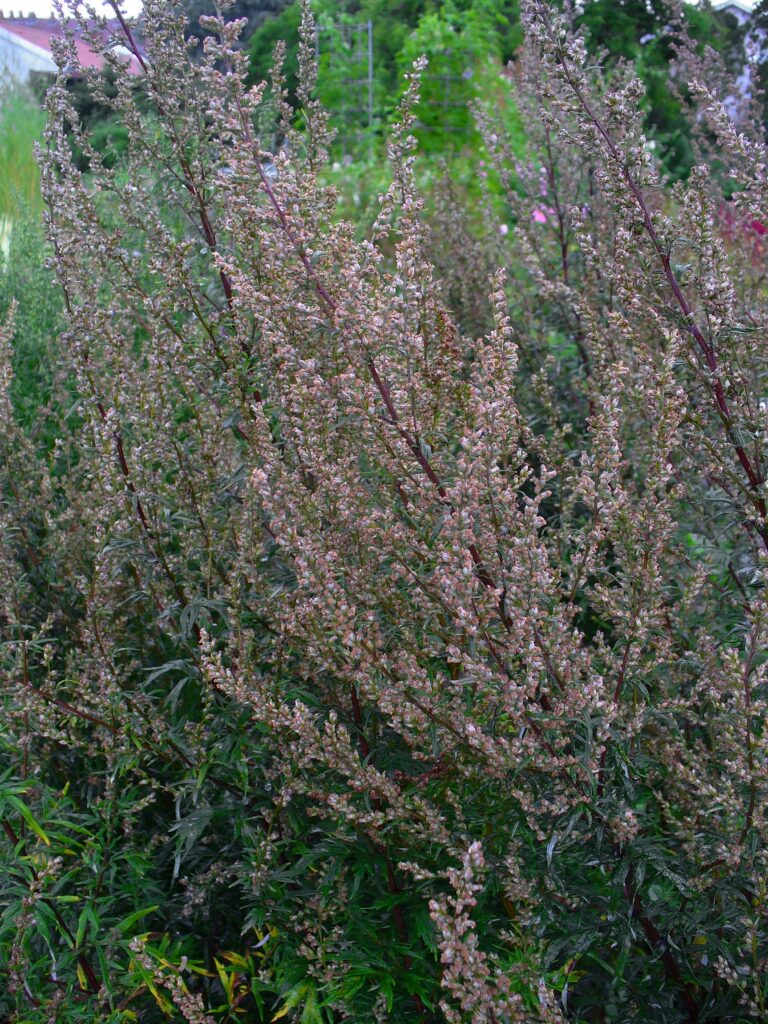
Mugwort (Artemisia vulgaris L.) is a perennial herbaceous plant in the Asteraceae (daisy) family, reaching heights of 1-2 meters. The stems are erect, rough-hairy, and often tinged reddish-purple. Leaves are deeply pinnately lobed, dark green above and characteristically silvery-white beneath due to dense pubescence. The plant exhibits high morphological and phytochemical variability depending on geographic location and growing conditions.1
Geographic Distribution & Habitat
Mugwort has widespread distribution across Europe, Asia, North and South America, and Africa. It thrives in temperate zones, adapting readily to disturbed soils including roadsides, riverbanks, field edges, and urban environments. In Northern New England, mugwort commonly grows as a naturalized species in sunny locations with disturbed soil.2
Active Compounds
The chemical composition of mugwort is notably variable but includes several key compound classes:
Essential Oils (variable composition):
– Monoterpenes: alpha-thujone, beta-thujone, 1,8-cineole (eucalyptol), camphor, camphene, borneol34
– Sesquiterpenes: germacrene D, beta-caryophyllene, caryophyllene oxide, alpha-humulene56
Sesquiterpene Lactones:
Psilostachyin, psilostachyin C, and vulgarin are characteristic of this species7
Flavonoids:
Twenty known flavonoids including apigenin, eriodictyol, luteolin, quercetin, isorhamnetin, kaempferol derivatives, and rutin8
Other Constituents:
Phenolic acids, coumarins (esculin, umbelliferone, scopoletin)7
Note on Thujone: The presence and concentration of thujone varies largely by species, climatic conditions, and soil where the plant is grown4
Pharmacological Actions
Peer-reviewed research has documented multiple biological activities:
Antioxidant: Numerous authors have confirmed beneficial properties of A. vulgaris herb extracts, including their antioxidant, hepatoprotective, antispasmolytic, antinociceptive, estrogenic, cytotoxic, antibacterial, and antifungal effects79
Anti-inflammatory & Immunomodulatory: Research studies have investigated biological effects including antioxidant, anti-inflammatory, anticancer, hypolipidemic, and antimicrobial properties1011
Digestive & Hepatoprotective: This species exhibits antioxidant, hypolipidemic, hepatoprotective, antispasmolytic, analgesic, estrogenic, cytotoxic, antibacterial, antifungal, hypotensive, and broncholytic effects7
Gynecological Effects: Mugwort in the treatment of menopause, premenstrual syndrome, dysmenorrhea was studied, with volunteers consuming mugwort extract experiencing reduced symptoms812
Safety & Interactions
Safety Class: The Botanical Safety Handbook lists Mugwort (Artemisia vulgaris) in Safety Class: 2b indicating it is not to be used in pregnancy due to its emmenagogue, uterine stimulant effects13
Cautions:
– Mugwort typically contains the neurotoxin compound thujone, though this varies greatly by species and environmental conditions4
– Not recommended during pregnancy unless under supervision of a medical expert4
– May cause allergic reactions in individuals sensitive to plants in the Asteraceae family (ragweed, chrysanthemums, daisies)14
– Contains thujone which in high concentrations may cause seizures14
Pregnancy/Nursing: Mugwort has traditional use as an emmenagogue (promoting menstruation) and has been employed historically to bring on delayed periods. This property makes it absolutely contraindicated during pregnancy and while nursing. Even external use or aromatherapy with Mugwort should be avoided during these times14
Growing in New England
Hardiness: Zones 3-9, extremely hardy for New England conditions
Soil: Adaptable to most soil types, prefers well-drained
Sun: Full sun to partial shade
Water: Drought-tolerant once established
Special notes:
– Naturalizes readily and can become invasive
– Spreads by rhizomes and self-seeds prolifically
– Considered a beneficial companion plant in gardens
– Important food source for pollinators
– Can be aggressive – plant with intention or contain
– Harvest aerial parts when in bloom (July-September in New England)
Pharmacological Actions: Analgesic, Anti-inflammatory, Antibacterial, Antifungal, Antinociceptive, Antioxidant, Antispasmolytic, Broncholytic, Cytotoxic, Emmenagogue, Estrogenic, Hepatoprotective, Hypolipidemic, Hypotensive
Traditional Herbalism Information
Energetics & Actions
Taste: Pungent, aromatic, bitter taste with sharp notes15
Temperature/Moisture: Generally regarded as a warming, drying plant that moves and tones digestion and circulation, moving stagnant blood flow and sluggish digestion15
Tissue States: Primarily used for the cold/depression, damp, and wind/tension tissue states15
Herbal Actions: Bitter Tonic, Carminative, Cholagogue/Choleretic, Nervine Sedative, Nervine Stimulant, Emmenagogue, Mild Uterine Antispasmodic, Mild Anthelmintic16
Parts Used & Their Applications
Leaves and Aerial Parts:
– Primary medicinal part in modern practice
– Digestive support and bitter tonic
– Nervous system support
– Used fresh or dried in teas, tinctures, and external preparations
Flowers:
– Aromatic and medicinal properties
– Often included with aerial parts harvest
– Used in incense and ritual preparations
Roots:
– Rarely used in modern herbalism
– Higher alkaloid content
– Stronger purgative action historically
Traditional Uses
Digestive Health
Seventeenth century herbalists noted mugwort’s effectiveness for digestive disorders. Bitter compounds in mugwort stimulate digestive secretions, potentially easing discomfort after rich meals. Traditional European herbalism classified mugwort as a digestive bitter and carminative, using it before meals to stimulate appetite or after meals to support digestion171815
Menstrual & Reproductive Support
Mugwort particularly shines as an emmenagogue (meaning it brings on menstruation) in cases of pelvic stagnation and delayed menses. Signs of pelvic stagnation can include dull, aching menstrual cramps, amenorrhea, or passing large dark clots during menstruation19
Herbalist Matthew Wood notes mugwort is particularly indicated when there is history of abuse, poverty, obstetric injury, scar tissue from abortion, or difficult pregnancies in women. Generally, it is “restorative to the injured female nature”20
Mugwort is an emmenagogue and stimulates menses in two distinct ways: it stimulates blood flow to the reproductive organs, relaxes a tense uterus, and encourages healthy blood flow with its pungent and aromatic compounds. It has a draining and downward-bearing action that encourages menses through its bitter tonic properties16
Nervous System Support
Mugwort is a relaxant to the nervous system, with nervine, carminative and antispasmodic actions15
Mugwort has an affinity for the nervous system and is a superb remedy for nervous digestion since it acts on the highway between the nervous and digestive systems16
Dream Support
Known as the ‘dream herb,’ mugwort can help bring ‘dreamy’ people who tend to be lost in their thoughts to feel more grounded and centered. Consuming mugwort either by ingesting or inhaling its smoke is linked with lucid dreaming1815
Liver & Gallbladder Support
Through Mugwort’s bitter and aromatic qualities, it disperses and supports a stagnant liver. Not often talked about, a stagnant liver is often the culprit behind PMS symptoms because it is responsible for breaking down and metabolizing complex reproductive hormones16
Preparation Methods
Mugwort Tea/Infusion
Steep 1-2 teaspoons of dried mugwort leaves in 8-10 ounces of hot water for 5-10 minutes. Cover while steeping to preserve volatile oils. Start with lower doses and shorter steep times due to bitter taste. Drink only small amounts at a time: a few sips after a meal will settle the stomach, a few sips before bed encourages vivid dreaming2122
Mugwort Tincture
Tinctures are concentrated herbal extracts at 1:5 herb to liquid ratio for dried herbs or 1:2 for fresh herbs in alcohol. Typical dosage ranges from 5-15 drops in water, taken up to three times daily23
Mugwort Smoke
Dried mugwort can be burned as incense or smoked (traditionally mixed with other herbs). Used for ritual purification, dream work, and creating sacred space. Ensure good ventilation24
Mugwort Infused Oil
Fresh wilted leaves (wilted 12-24 hours to reduce moisture) infused in oil using folk method or gentle heat. Not for internal use. Used externally for massage or ritual anointing
Dream Pillow
Dried mugwort placed in small cloth sachet and placed under or near pillow to enhance dreams and dream recall25
Harvest Notes
Aerial Parts (leaves, stems, flowers):
– Harvest when in full bloom (July-September in New England)
– Cut stems leaving roots intact for regrowth
– Harvest in dry morning after dew has evaporated
– Never take more than 1/3 from any patch
– Dry quickly in bundles hung upside down or spread on screens
– Store dried herb in airtight containers away from light
Best Locations:
– Roadsides and field edges (avoid contaminated areas)
– Disturbed soils where it naturalizes
– Your own garden if cultivated
– Avoid areas treated with chemicals
Storage: Dried mugwort in airtight containers away from light and moisture. Use within 1 year for best potency
Contraindications & Cautions
Absolutely contraindicated:
– Pregnancy and nursing14
– Trying to conceive (avoid during second half of cycle post-ovulation)14
– Known seizure disorders (due to thujone’s interaction with GABA receptors)14
Use with caution:
– Asteraceae family allergies (ragweed, chrysanthemums, marigolds, daisies) – may cause allergic reactions14
– Those on blood thinners (theoretical interaction)
– Long-term or excessive use (artemisia plants contain compounds that may build up with chronic use – take periodic breaks)26
Never:
– Ingest essential oils – toxic and can cause permanent liver/kidney damage26
– Use during pregnancy for any purpose including aromatherapy14
Traditional Uses: Amenorrhea, Carminative, Cough, Digestive Support, Dream Enhancement, Dysmenorrhea, Emmenagogue, Gentle Laxative, Liver Support, Menstrual Support, Nervine, Nervous Tension, PMS, Respiratory Support
Magical Correspondences Information
Magical Correspondences
Planetary Ruler: The Moon rules over Mugwort. Venus is also occasionally associated with mugwort as the ruler of many healing herbs2728
Element: Earth2930
Gender: Feminine30
Zodiac: Taurus and Libra (Venus-ruled signs); also associated with Pisces2830
Chakras: Third-Eye and Crown28
Day: Friday (Venus day)30
Deities & Mythology
Associated with Artemis and Diana, lunar goddesses30
The genus Artemisia is named for the Greek Goddess Artemis (Roman Diana), goddess of the moon, making mugwort an herb strongly connected to lunar magic and the divine feminine31
Called ‘the oldest of plants’ (yldost wyrta) by the Anglo-Saxons, it is a key ingredient in the “Charm of the Nine Worts,” a magic herbal formula believed to be given to the world by the god Woden32
Magical Intentions & Uses
Divination & Psychic Development
Mugwort amplifies psychic vision and may induce prophetic dreams. When paired with a divinatory method of your choice, Mugwort is an excellent helper for confronting difficult truths2931
Scott Cunningham notes: “The infusion is also used to wash crystal balls and magic mirrors, and mugwort leaves are placed around the base of the ball (or beneath it) to aid in psychic workings”29
Mugwort is said to boost psychic and intuitive abilities, and is recommended before and during working with tarot, oracle cards, runes, or other divinatory practices3334
Dream Work & Astral Travel
A sprig of Mugwort under the mattress is believed to encourage astral projection and lucid dreams35
Mugwort tea can be drunk to aid in dream recall. Add dried Mugwort to dream pillows when you wish to have prophetic dreams30
Protection & Purification
Mugwort has long been considered a protective herb and is revered for its ability to banish negative energy and ward off evil spirits. It can be burned in the home to banish negative energy, or it can be burned outside the front door to create a protective barrier35
Ancient Romans planted Mugwort along roadsides so travelers could line their shoes with it to relieve aching feet. St. John the Baptist is said to have worn a girdle of Mugwort for protection when he set out into the wilderness32
Though mugwort is known for intuition, it is equally valued as a protective herb. Its lunar qualities do not make it passive or receptive only—mugwort actively shields, seals, and deflects unwanted spiritual interference36
Spiritual Cleansing
Mugwort can be used for smoke cleansing, and is a much more eco-friendly and sustainable alternative to white sage. A smoke cleansing wand made with mugwort is perfect to purify and sanctify a ritual space before any magical working34
Ritual Uses & Preparations
Incense
Mugwort can be used as an incense to induce a trance state and aid in divination. Burn as an incense with Sandalwood and Wormwood to increase psychic communication during scrying rituals30
Moon Water
Mugwort moon water combines the herb’s properties with lunar energy, creating a versatile tool for ritual work throughout the month. Unlike tea, this preparation isn’t meant for drinking—it serves as a spiritual tool for blessing, cleansing, and consecrating14
Best timing: Full moon evenings for amplification and clarity; new moon for introspection and shadow work; or any evening before important divination, ritual, or dreamwork practice
Dream Pillows & Sachets
A popular way to use mugwort is to stuff a small pillow or sachet with dried mugwort leaves and flower buds. Place the mugwort pillow beneath your regular pillow when you sleep to promote lucid dreaming and gain insight from your dreams. Keep a dream diary on your nightstand34
Divination Tool Cleansing
Readers often cleanse their cards, mirrors, shells, pendulums, or bowls with mugwort-infused water or smoke. The herb sharpens focus, softens distractions, and opens the spiritual senses needed for accurate interpretation. Mugwort can also be placed beside reading tools to maintain their clarity between sessions36
Protection Sachets
Mugwort leaves and flowers for gentle protection, especially for children, sensitive people, or protection during sleep. Hang Mugwort from windows/doorways to repel negative energy. Placing Mugwort next to the bed is said to aid astral projection30
Ritual Timing
Work with mugwort during:
– Full Moon ceremonies for amplification
– New Moon for introspection and shadow work
– Friday (Venus day) for love and beauty work
– Monday (Moon day) for lunar magic
– During dream work and divination practices
Traditional Lore & Folk Magic
Anglo-Saxon Heritage: Mugwort was mentioned in the Nine Herbs Charm, a 10th-century English rhyme of beneficial herbs. Later, it was associated with St. John the Baptist, and wreaths of Mugwort were worn to repel evil spirits29
Roman Tradition: Ancient Romans used it consistently, even planting Mugwort along roadsides so that soldiers and travelers could put it in their sandals to relieve aching feet31
Medieval Practice: Called “Mother of Herbs” in the Middle Ages, reflecting both medicinal versatility and special role in accessing non-ordinary states of consciousness37
Fairy Associations: In Celtic Europe, Druids recognized Mugwort as one of their nine sacred herbs, employing it in divination rituals and as protection for travelers journeying between the physical and spirit worlds37
Dream Herb Tradition: Cultures from medieval Europe to indigenous North America recognized mugwort’s connection to the dream world. Some people experience more vivid, memorable, or lucid dreams when using mugwort18
Protection Magic: Traditionally hung over doorways or windows to keep evil spirits and negativity away from the home. Some also weave it into wreaths or protective charms to safeguard their living space from unwanted energies38
Invisibility Magic: Traditional folk magic – carrying mugwort helps you “blend in” or go unnoticed when needed. Not literal invisibility but energetic subtlety
Working with Mugwort in Practice
Before working with mugwort: Bring your environment and spirit into alignment with your intention. Begin by cleansing the space using incense, Florida Water, or simple blend of water and salt. Take a moment to sit quietly and name your purpose. Mugwort works best when the practitioner states clearly what they are seeking, whether it is insight, protection, cleansing, or ancestral guidance36
Third Eye Activation: In chakra-based energy work, Mugwort has long been associated with the sixth chakra or “third eye”—the energetic center located at the brow point. This chakra governs intuition, inner vision, psychic perception, and ability to see beyond surface appearances37
Combining with Other Herbs:
– With Lavender for gentler dreams
– With Wormwood (masculine energy) to balance mugwort’s feminine energy
– With Sandalwood for enhanced divination work
– Alone for pure lunar/psychic work
Cautions for Magical Use
While mugwort is safe for external magical use (incense, sachets, ritual baths), remember:
– Pregnant individuals should avoid even aromatherapy use14
– Those with ragweed allergies may react to pollen in dried mugwort26
– Start with small amounts in dream pillows to assess sensitivity
– Good ventilation when burning as incense
– Not all mugwort species are interchangeable – A. vulgaris (common mugwort) is gentler than A. absinthium (wormwood) which has higher thujone content14
Planetary Rulers: Moon, Venus
Magical Intentions: Astral Travel, Divination, Dreams, Lucid Dreaming, Prophetic Dreams, Protection, Psychic Work, Purification, Scrying
Elemental Associations: Earth
1 Kowal, A., Rusinska, A., et al. (2020). Significance of Artemisia Vulgaris L. (Common Mugwort) in the History of Medicine and Its Possible Contemporary Applications Substantiated by Phytochemical and Pharmacological Studies. Molecules, 25(19), 4415. https://pmc.ncbi.nlm.nih.gov/articles/PMC7583039/
2 Sharma, D., & Nargotra, D. (2022). Artemisia vulgaris Linn: an updated review on its multiple biological activities. Future Journal of Pharmaceutical Sciences, 8, Article 436. https://fjps.springeropen.com/articles/10.1186/s43094-022-00436-2
3 Wikipedia contributors. (2025). Mugwort. In Wikipedia, The Free Encyclopedia. https://en.wikipedia.org/wiki/Mugwort
4 Kowal, A., et al. (2020). Chemical composition of essential oils of Artemisia vulgaris. Molecules. https://www.mdpi.com/1420-3049/25/19/4415
5 Judžentiene, A., & Budiene, J. (2008). Volatile constituents from aerial parts and roots of Artemisia vulgaris grown in Lithuania. Chemija, 19, 25-28.
6 Santos, P.A., et al. (2012). Chemical Profile and Biological Activities of Essential Oil from Artemisia vulgaris L. Cultivated in Brazil. Evidence-Based Complementary and Alternative Medicine. https://pmc.ncbi.nlm.nih.gov/articles/PMC6631396/
7 Kowal, A., Rusinska, A., et al. (2020). Phytochemical composition and pharmacological properties. Molecules, 25(19), 4415.
8 Sharma, D., & Nargotra, D. (2022). Phytochemical and pharmacological investigations. Future Journal of Pharmaceutical Sciences, 8.
9 Efferth, T., et al. (2015). Nobel Prize for artemisinin brings phytotherapy into the spotlight. Phytomedicine, 22, 1-4.
10 Bora, K.S., & Sharma, A. (2011). The genus Artemisia: a comprehensive review. Pharmaceutical Biology, 49(1), 101-109.
11 Nigam, M., et al. (2019). Therapeutic potential of Artemisia vulgaris: An insight into underlying immunological mechanisms. Journal of Ethnopharmacology. https://pubmed.ncbi.nlm.nih.gov/31679308/
12 Adams, J.D., Garcia, C., & Garg, G. (2012). Mugwort in the treatment of menopause, premenstrual syndrome, dysmenorrhea. Chinese Medicine, 3(3), 116-123.
13 McGuffin, M., Hobbs, C., Upton, R., & Goldberg, A. (1997). American Herbal Products Association’s Botanical Safety Handbook. CRC Press.
14 Sacred Plant Co. (2024). The Spiritual Use of Mugwort: Dreams, Intuition & Rituals. https://sacredplantco.com/blogs/natures-pharmacy-exploring-the-historical-uses-and-health-benefits-of-medicinal-herbs/the-spiritual-use-of-mugwort-the-dreamweaver-for-intuition-and-visionary-journeys
15 Herbal Reality. (2026). Mugwort (Artemisia vulgaris): Benefits, Safety, Uses. https://www.herbalreality.com/herb/mugwort/
16 School of Evolutionary Herbalism. (2025). Mugwort: The Herb of Dreams. https://www.evolutionaryherbalism.com/2025/02/19/mugwort-the-herb-of-dreams/
17 Grieve, M. (1931). A Modern Herbal. Dover Publications (1971 reprint). Mugwort entry.
18 Sacred Plant Co. (2023). Mugwort: The Mystical Dream Herb’s Odyssey. https://sacredplantco.com/blogs/natures-pharmacy-exploring-the-historical-uses-and-health-benefits-of-medicinal-herbs/mugwort-the-mystical-dream-herbs-odyssey
19 Learning Herbs. (2024). Mugwort Uses and Plant Profile. https://www.learningherbs.com/blog/mugwort-uses
20 Wood, M. (2008). The Earthwise Herbal Volume I: A Complete Guide to Old World Medicinal Plants. North Atlantic Books.
21 The Alchemist’s Kitchen. (2022). Mugwort: Wise Dreamweaver. https://wisdom.thealchemistskitchen.com/mugwort-wise-dreamweaver/
22 Sacred Treatments. (2025). The Medicinal Uses of Mugwort: A Comprehensive Guide. https://sacredtreatments.com/the-medicinal-uses-of-mugwort-a-comprehensive-guide/
23 Natural Fertility Info. (2021). Mugwort: Ancient Herb for Absent Periods. https://natural-fertility-info.com/mugwort.html
24 Moon & Leaf Magic. (2025). The Magic Of Mugwort: How To Use Mugwort In Your Magical Workings. https://moonleafmagic.com/mugwort-magic/
25 Moonsence. (2025). 5 Magical & Herbal Uses of Mugwort. https://www.moonsence.com/blogs/news/5-magical-herbal-uses-for-mugwort
26 Grove and Grotto. (2017). Magickal properties of Mugwort. https://www.groveandgrotto.com/blogs/articles/magickal-properties-of-mugwort
27 Ancient Astrology. (2021). The Planetary Rulerships of Plants. https://www.ancientastrology.com/articles-/the-planetary-rulership-of-plants
28 Rite of Ritual. Ritual Herbs – Mugwort. https://riteofritual.com/products/ritual-herbs-mugwort
29 Grove and Grotto. (2017). Magickal properties of Mugwort. https://www.groveandgrotto.com/blogs/articles/magickal-properties-of-mugwort
30 Curious Cauldron. (2024). The Magickal Properties Of Mugwort. https://curiouscauldron.com.au/blogs/sacred-space/the-magickal-properties-of-mugwort
31 Crystal Vaults. (2023). Mugwort Meaning, Healing, and Magical Uses. https://www.crystalvaults.com/magical-herbs/mugwort/
32 The Alchemist’s Kitchen. (2022). Mugwort: Wise Dreamweaver. https://wisdom.thealchemistskitchen.com/mugwort-wise-dreamweaver/
33 Coventry Creations. (2024). Mugwort: A Psychic’s Favorite Herb. https://coventrycreations.com/articles-3/herb-magic/entry/1515-mugwort-a-psychic%E2%80%99s-favorite-herb
34 Moon & Leaf Magic. (2025). The Magic Of Mugwort. https://moonleafmagic.com/mugwort-magic/
35 Art of the Root. (2023). Magical Properties of Mugwort. https://artoftheroot.com/blogs/spells-and-rituals/magical-properties-of-mugwort
36 Original Botanica. (2025). The Sacred Magic of Mugwort: Dreams, Protection, and Ancestral Sight. https://originalbotanica.com/blog/mugwort-magical-properties-uses
37 Sacred Plant Co. (2024). The Spiritual Use of Mugwort. https://sacredplantco.com/blogs/natures-pharmacy-exploring-the-historical-uses-and-health-benefits-of-medicinal-herbs/the-spiritual-use-of-mugwort-the-dreamweaver-for-intuition-and-visionary-journeys
38 Moonsence. (2025). 5 Magical & Herbal Uses for Mugwort. https://www.moonsence.com/blogs/news/5-magical-herbal-uses-for-mugwort