Partridgeberry
Basic Information
Scientific Name: Mitchella repens
Plant Family: Rubiaceae
Conservation / Invasive Status: Not listed (Locally abundant, slow-growing)
Geographic Range: Northern New England | Northeast US | Eastern North America
Safety Level: Generally Safe
Harvest Season: Fall, Spring, Summer
Parts Used: Aerial Parts, Berries, Leaves, Whole Plant
Scientific & Botanical Information
Active Compounds
Partridgeberry contains tannins and saponins as primary identified constituents. The specific types and concentrations of these compounds have not been thoroughly characterized in modern phytochemical literature. Alkaloids and other secondary metabolites may be present but remain undocumented. The plant’s traditional use as a parturient (labor aid) suggests potential oxytocic compounds, though these have not been isolated or characterized.
What Science Shows
Modern pharmacological research on Mitchella repens is minimal. No controlled clinical trials examining its parturient, urinary, or nervine properties have been published. The presence of tannins and saponins supports traditional uses for urinary tract health and general toning, but scientific validation is lacking. The oxytocic properties traditionally attributed to this plant have not been pharmacologically confirmed. Traditional ethnobotanical use by indigenous peoples is the primary basis for current knowledge.
Growing in New England
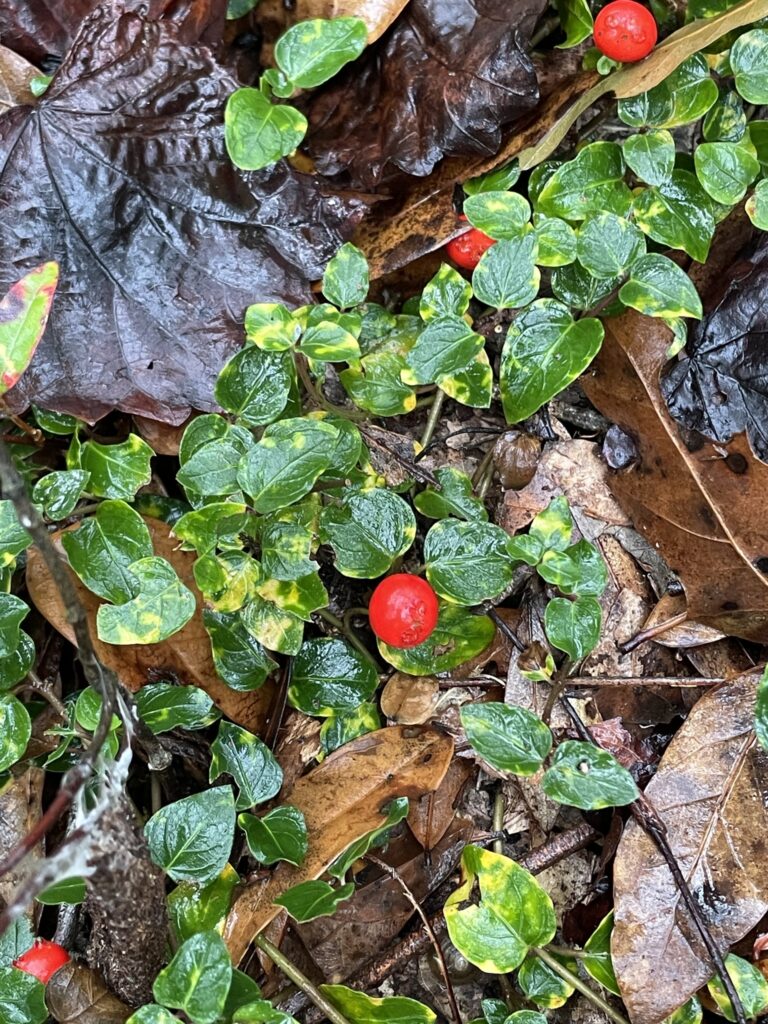
Partridgeberry is a native evergreen groundcover thriving in moist, acidic woodlands, forest floors, and swampy areas throughout New England. It prefers dappled shade to partial shade and spreads slowly via trailing runners to form delicate mats. The small white or pale pink twin flowers appear in late spring (May-June), and the distinctive bright red berries persist through winter, providing food for wildlife. This delicate plant is difficult to transplant and requires consistent moisture and shade to thrive outside its natural habitat.
Safety & Interactions
Partridgeberry has traditionally been used during pregnancy and labor, suggesting a reasonable safety profile, though modern safety documentation is limited. Tannins and saponins can cause gastrointestinal irritation in excessive quantities. Not recommended for use without professional guidance, particularly during pregnancy, despite traditional applications. Interactions with medications are undocumented. The plant’s endangered status in some regions argues for caution in harvesting.
New England Specific
Mitchella repens is native throughout New England and represents an important indicator species for high-quality forest habitat. Populations have declined in some areas due to habitat loss and over-harvesting. This plant should be considered for conservation and is best appreciated in its native setting rather than harvested.
Pharmacological Actions: Anti-inflammatory, Antimicrobial, Astringent, Hemostatic, Tonic (uterine), Vulnerary
Traditional Herbalism Information
Parts Used & Their Applications
According to Moerman (1998), indigenous peoples of the Northeast and broader regions used the entire aerial portion of Partridgeberry medicinally. The root was also harvested for specific applications. Traditional preparations used fresh or dried plant material. The berries were occasionally used in remedies, though the aerial parts were primary.
Preparation Methods
Traditional preparations included infusions and decoctions of the aerial parts and roots. The plant was steeped in water for tea or decocted with other plants for combined effect. Poultices of fresh plant material were applied externally. Tinctures were made by macerating plant material in alcohol. Historical doses and specific recipes remain incompletely documented in herbal literature.
Traditional Applications
Moerman documents traditional use as a parturient—specifically, the plant was used during pregnancy and labor to ease delivery. It was also valued as a urinary tract tonic and a nervine (nerve-calming herb). Some traditions employed it for female reproductive health more broadly, including menstrual regulation and support for menopausal transitions. Poultices were applied externally for wounds and skin conditions. The berries were sometimes consumed as food and medicine.
Modern Adaptations
Contemporary herbalists, particularly those focused on women’s health and ethnobotany, have maintained knowledge of Partridgeberry’s traditional applications. However, responsible practitioners emphasize the lack of modern safety documentation and the plant’s conservation status. Some contemporary herbalists use it cautiously for urinary tract support and general female reproductive toning, often in blended formulas with other documented herbs. Internal use during pregnancy is generally not recommended without professional guidance.
New England Specific
New England indigenous peoples had extensive knowledge of Partridgeberry’s applications for women’s health and general wellness. This knowledge has been partially preserved through ethnobotanical documentation. Contemporary New England herbalists honor this tradition while respecting conservation concerns.
Harvest Notes
Sustainable harvesting is critical due to declining populations in some areas. If harvesting is considered, only minimal amounts should be taken from any location, and never from rare or localized populations. The entire aerial portion can be cut cleanly with scissors or shears, leaving the root system intact for regeneration. Harvest in late summer or fall when the plant is most robust. Dried material should be stored in cool, dry conditions and used within 2 years.
Traditional Uses: Childbirth Preparation, Hemorrhage Prevention, Menstrual Support, Reproductive Support, Women's Health (uterine tonic)
Magical Correspondences Information
Magical Correspondences
Partridgeberry carries Saturn’s grounded, protective, and boundary-honoring energy, paired with Earth element qualities. The evergreen nature speaks to endurance and continuity through dark times. The twined flowers suggest partnership and the sacred union of masculine and feminine principles. The persistent red berries are symbols of life force, nourishment, and wisdom earned through patience.
Magical Intentions
This plant supports magic for women’s strength, protective boundaries, grounding, and endurance. It is valuable for work supporting childbirth, maternal health, and generative power. Partridgeberry’s slow, steady growth and persistent berries make it useful for building long-term protection, stability, and resilience. Magic involving partnership, balance of opposites, and sacred union benefit from this plant’s influence. It is suitable for work honoring ancestral feminine wisdom and earth-based knowledge.
Ritual Uses
Dried Partridgeberry can be included in protective sachets, particularly those honoring women’s strength and boundary-setting. Fresh or dried berries and leaves are suitable for altar offerings honoring ancestors and the feminine divine. The plant can be incorporated into rituals supporting pregnancy, childbirth, and postpartum recovery (in non-consumptive ways). Pressed flowers and berries work well in charm bags for grounding and endurance magic.
Color Correspondences
The evergreen foliage carries deep green, representing stability, growth, and earth wisdom. The bright red berries carry passion, life force, blood, and the sacred red of feminine power and menstruation. Together they create a signature honoring the earth, endurance, and the sacred cycles of the female body.
Sabbat Associations
The persistent winter berries connect Partridgeberry to Yule (winter solstice) and the promise of life in darkness. Imbolc (February 1) celebrates new potential and the stirring of life, aligning with Partridgeberry’s associations with childbirth and generation. The spring flowers connect to Beltane (May 1) and fertility themes.
Traditional Lore & Folk Magic
Indigenous traditions honored Partridgeberry as a sacred plant supporting women through pregnancy and childbirth. The twin flowers were understood as representing the union of opposites and the balance required for successful labor. The persistent red berries were valued as symbols of endurance, blood wisdom, and the continuity of life across generations.
Combining with Other Plants
Partridgeberry pairs naturally with other Saturn-ruled herbs (Comfrey, Plantain) for grounding and protection work. It combines well with other evergreen forest plants (Northern Whitecedar, Wintergreen) for forest-based ceremonies. In women’s health magic, it harmonizes with other feminine-honoring plants (Red Clover, Lady’s Mantle). Its native forest status makes it powerful in bioregional New England magic.
Planetary Rulers: Moon
Magical Intentions: Ancestral Work, Fertility, Grounding, Lunar Magic, Pregnancy/Childbirth, Women's Magic
Elemental Associations: Earth, Water