Pearly Everlasting
Basic Information
Scientific Name: Anaphalis margaritacea
Plant Family: Asteraceae
Conservation / Invasive Status: Secure
Geographic Range: Northern New England
Safety Level: Generally Safe
Harvest Season: Fall, Summer
Parts Used: Aerial Parts, Flowers, Leaves
Scientific & Botanical Information
Botanical Description
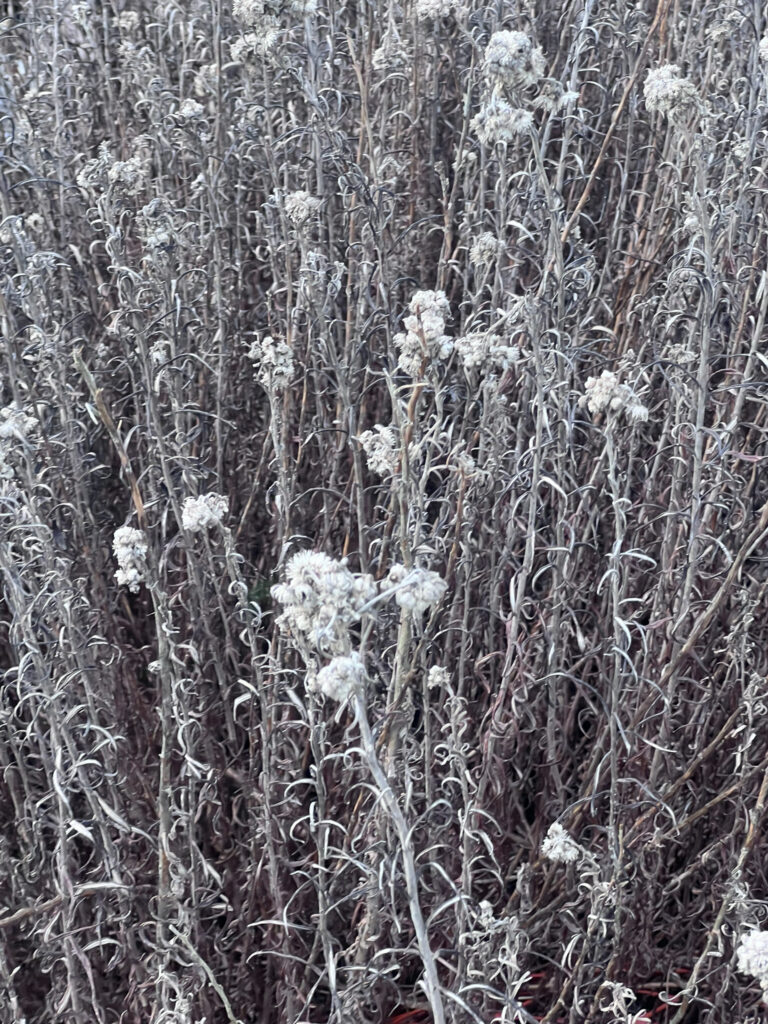
Anaphalis margaritacea, commonly known as Pearly Everlasting, is a low-growing to semi-erect perennial herb of the Asteraceae family, typically reaching heights of 30 to 60 centimeters (12–24 inches), though capable of taller growth under optimal conditions. The plant is characterized by narrow, linear leaves with a distinctive silvery-gray color imparted by fine pubescence, creating a distinctive visual appearance even from a distance.1 The diagnostic feature is the dense clusters of papery white flower heads composed of persistent involucral bracts surrounding inconspicuous central flowers, remaining intact for extended periods even when the plant has fully senesced—hence the evocative name “everlasting.” The flowers appear in dense, flat-topped or slightly rounded corymbs from mid-summer through autumn, providing long-lasting ornamental and medicinal material. The root system is relatively shallow but extensively branched, enabling rapid colonization of open ground.
Geographic Distribution & Habitat
Anaphalis margaritacea exhibits an interrupted circumboreal distribution, with populations in North America extending from Labrador and Newfoundland westward to Alaska, and southward to the Carolinas, Tennessee, Oklahoma, Texas, New Mexico, and California.2 Asian populations occur in China, the Russian Far East, Japan, Korea, northern Indochina, and the Himalayas, with the species reportedly naturalized in Europe despite non-native status. In Northern New England, the plant occurs in dry, stony meadows, mountain grasslands, disturbed roadsides, and abandoned agricultural areas, demonstrating considerable soil and moisture tolerance. The species prefers well-drained, sandy or gravelly substrates and thrives in full sun to light shade positions. The plant’s abundance in dry upland habitats distinguishes it ecologically from the wetter-habitat preferences of other common New England asters.
Active Compounds
Phytochemical analysis of Anaphalis margaritacea has identified flavonoid compounds as significant bioactive constituents, with documented presence of quercetin, kaempferol, apigenin, and other flavonoid derivatives contributing antioxidant and anti-inflammatory activities.3 Triterpenoid compounds, identified through chromatographic analysis, complement the flavonoid fraction in supporting multiple pharmacological actions.3 Hydroxylactone constituents unique to the genus Anaphalis contribute additional bioactivity, potentially accounting for historical medicinal uses not explained by more common phytochemical constituents. Essential oil analysis reveals diverse volatile terpenes responsible for the plant’s characteristic odor and contributing to expectorant and antimicrobial actions. Polysaccharide fractions present in leaf tissues demonstrate immunomodulatory properties, supporting both traditional immune-support uses and contemporary herbal applications.
Pharmacological Actions
Anaphalis margaritacea exhibits multiple pharmacological actions documented in both traditional use patterns and contemporary phytochemical analysis. The expectorant action, the plant’s most prominent therapeutic property, is mediated through volatile essential oil components and polysaccharide fractions that stimulate mucus production and facilitate productive coughing, enabling the body to clear respiratory congestion.4 Anti-inflammatory activity, driven by flavonoids and hydroxylactones, reduces inflammatory cytokine production and suppresses inflammatory enzyme activity, particularly relevant for inflammatory respiratory and skin conditions. Antimicrobial activity encompasses bacterial and fungal pathogens through the synergistic action of essential oils, flavonoids, and hydroxylactone constituents. Diaphoretic properties, well-documented in traditional use, promote perspiration and heat release, supporting fever reduction and the body’s natural thermal regulation. Astringent action addresses mucosal laxity through tannin and flavonoid effects, beneficial for addressing excessive respiratory secretion. Antioxidant activity reduces cellular oxidative stress through multiple enzymatic and non-enzymatic pathways.
Safety & Interactions
Anaphalis margaritacea is widely recognized as safe for use in the general population, lacking hepatotoxic alkaloids, known teratogenic compounds, or serious adverse effects documented in traditional or contemporary herbal literature.1 The plant exhibits no documented drug interactions with conventional pharmaceuticals and is appropriate for concurrent use in individuals on multiple medications. Allergic reactions remain theoretically possible in individuals with documented Asteraceae family sensitivities, though such reactions are exceptionally rare with this species. The plant is suitable for use during pregnancy and lactation when consumed in culinary or mild medicinal quantities, though practitioners should consult with qualified healthcare providers in these contexts. The exceptional safety profile enables broad population access to this plant’s therapeutic benefits without restriction or special precautions.
Growing in New England
Anaphalis margaritacea establishes readily in Northern New England gardens and landscapes, thriving in dry to moderately moist soils with good drainage and full sun exposure. The plant requires minimal care once established, making it suitable for low-maintenance landscapes and native plant gardens. Seeds should be surface-sown indoors in spring, as they require light for germination; seedlings can be transplanted to the garden after the last frost date. Division of mature plants every three to four years refreshes older specimens. The plant spreads gradually through rhizomatous root growth, forming expanding colonies over time. In New England gardens, the plant provides reliable late-summer and fall interest with its silvery foliage and white flower heads, attracting native pollinators and providing food resources for migrating monarch butterflies. Minimal deadheading allows seed maturation and supports wildlife.
Pharmacological Actions: Anti-inflammatory, Antimicrobial, Antioxidant, Astringent, Diaphoretic, Diuretic, Expectorant
Traditional Herbalism Information
Energetics & Actions
In traditional herbalism, Anaphalis margaritacea is characterized as slightly warming, bitter-astringent, and possessing a distinctive affinity for the respiratory system and the body’s ability to mobilize and eliminate moisture.5 The plant’s traditional emphasis as an expectorant and respiratory support herb indicates its therapeutic alignment with conditions characterized by thick, stagnant mucus and congested airways. The taste profile—aromatic and subtly bitter—aligns with traditional doctrine of signatures suggesting respiratory affinity. Herbalists recognize the plant’s gentle nature, making it suitable for extended use and for populations including young children and elderly individuals. The plant’s diaphoretic or sweat-promoting property demonstrates affinity for febrile conditions and the body’s need to mobilize and release accumulated heat.
Parts Used & Their Applications
The aerial parts of Anaphalis margaritacea—stems, leaves, and flowers—constitute the primary medicinal material, traditionally harvested during peak flowering in July through September.4 Flowers, separated from vegetative stems, offer optimal aesthetic presentation in herbal tea blends and concentrates the plant’s bioactive compounds. Leaves provide balanced action and integrate seamlessly into bulk herbal formulations. The entire aerial portion, dried and chopped, suits infusion or decoction and enables comprehensive extraction of both water-soluble and more lipophilic compounds. Fresh plant material, used in tincture preparation, offers enhanced enzymatic activity and potentially superior expectorant action. The dried aerial parts retain medicinal efficacy for two to three years when stored in cool, dark conditions in airtight containers, making the plant an excellent choice for long-term herbal supply development.
Traditional Uses: Anti-inflammatory, Asthma support, Cough remedy, Expectorant, Fever Reduction, Respiratory Support, Wound Healing
Magical Correspondences Information
Planetary & Elemental Associations
Anaphalis margaritacea carries a strong Moon association in contemporary magical herbalism, reflecting the planet’s rulership over memory, dreams, the subconscious, and the veil between worlds.7 The plant’s white flowers and silvery foliage directly correspond to lunar symbolism and the Moon’s silvery light. Water element association arises from both the Moon’s traditional rulership and the plant’s gentle, flowing energy. Some magical practitioners also recognize Air element connection, drawing from the plant’s ability to “lighten” stuck emotional or energetic states through facilitating release, similar to how it mobilizes stuck respiratory secretions. The plant’s “everlasting” nature—flowers persisting long after normal blooming seasons end—associates it with permanence, memory, and ancestral presence.
Planetary Rulers: Moon
Magical Intentions: Ancestral Work, Dreams, Healing, Memory, Protection, Psychic Work, Purification, Transition
Elemental Associations: Air, Water
1. North Carolina State University Extension Gardener Plant Toolbox. “Anaphalis margaritacea (Pearly Everlasting, Sweet Everlasting, Western Pearly Everlasting).” https://plants.ces.ncsu.edu/plants/anaphalis-margaritacea/
2. Wildflower.org (Lady Bird Johnson Wildflower Center). “Anaphalis margaritacea (Western pearly everlasting).” https://www.wildflower.org/plants/result.php?id_plant=anma