Red Trillium
Basic Information
Scientific Name: Trillium erectum
Plant Family: Melanthiaceae
Conservation / Invasive Status: At-Risk (United Plant Savers), Threatened/Protected in several states
Geographic Range: Eastern North America, Northeast US, Northern New England
Safety Level: Use with Caution
Harvest Season: Spring
Parts Used: Rhizome, Roots
Scientific & Botanical Information
Active Compounds
Trillium erectum (Red Trillium, also known as Wake-robin or Birthroot) is a member of the Melanthiaceae family (formerly Liliaceae) and has not been subjected to comprehensive phytochemical analysis in modern scientific literature. Traditional use suggests bioactive constituents, but their identification remains outstanding. The rhizome, the primary medicinal part, likely contains compounds characteristic of Trillium species, possibly including saponins and other water-soluble compounds, though this has not been verified. The plant’s chemistry remains largely undocumented.
What Science Shows
Scientific research on Trillium erectum is essentially absent. No phytochemical analyses, pharmacological screening, or clinical trials specific to T. erectum have been published in major scientific databases. Related Trillium species have received minimal research attention from a medicinal perspective. The plant’s traditional use in North American indigenous and folk herbalism, particularly for reproductive support, has not been validated through controlled research. German Commission E provides no monograph for this species.
Growing in New England
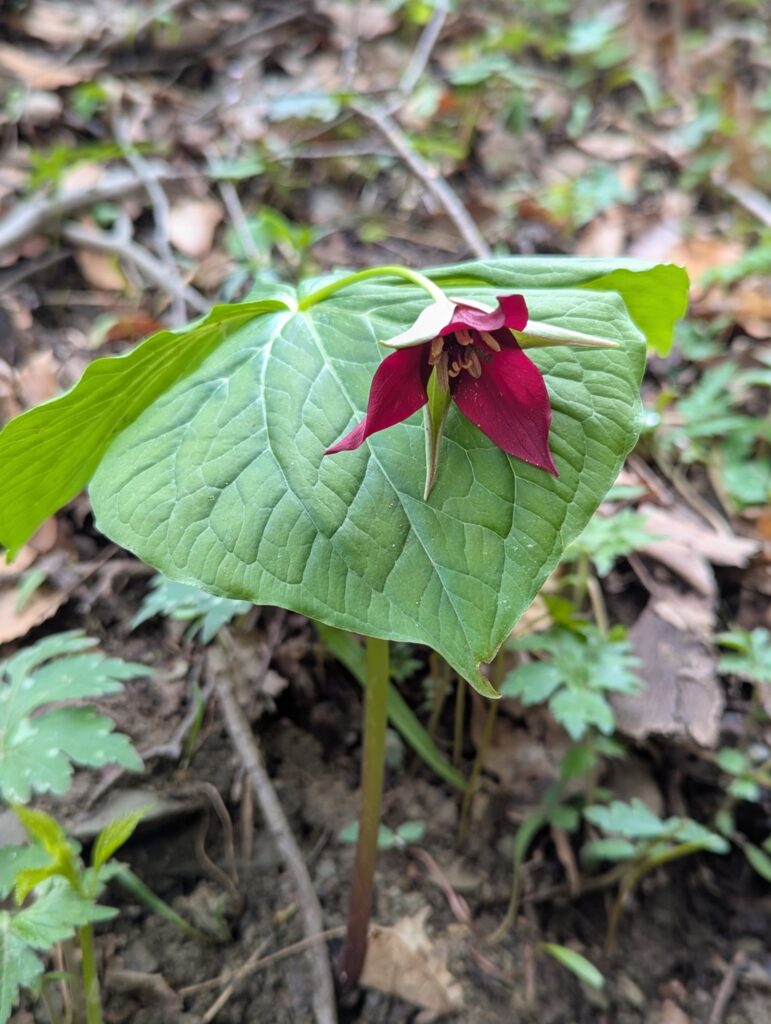
Trillium erectum is a native herbaceous perennial, found throughout New England in deciduous and mixed forests with rich, moist soil. Establishes from seed; growth is very slow, with plants taking 5-8 years to reach reproductive maturity. Prefers partial to full shade and consistently moist, rich, humus-laden soil. Produces distinctive deep red (occasionally white or pink) three-petaled flowers in spring (May). The plant’s ecological role as a spring ephemeral and pollinator-attracting flower is significant.
Safety & Interactions
Red Trillium has no documented acute toxicity, though traditional use by indigenous midwives suggests pharmacological activity. The plant’s traditional use for reproductive support indicates bioactive compounds, but their nature and safety profile at various doses remain unstudied. Some herbalists exercise caution with internal use during pregnancy due to the plant’s traditional reproductive applications, though rigorous safety data is lacking. No significant herb-drug interactions are documented. Lactation safety is unstudied.
New England Specific
Red Trillium is a native plant with deep significance in New England ecology and indigenous herbalism. The plant’s slow growth and specific habitat requirements make it vulnerable to overharvesting; sustainable practices are essential.
Pharmacological Actions: Anti-inflammatory, Antifungal, Antioxidant, Astringent, Emmenagogue, Uterine Stimulant
Traditional Herbalism Information
Parts Used & Their Applications
The rhizome is the primary medicinal part, traditionally harvested in fall (September–October) when vital forces move downward into the root. Some herbalists use the aboveground plant during growing season, though this is less traditional.
Preparation Methods
Decoction (traditional): Simmer 1–2 teaspoons dried rhizome in 1 quart water for 15–30 minutes, strain. Consume as a tea, 1–3 cups daily (often taken in smaller, frequent doses). Cold infusion: Overnight steeping of dried rhizome in cold water, drunk as desired. Tincture: Fresh or dried rhizome in 50% alcohol, 1:2 ratio, 20–40 drops 2–3 times daily.
Traditional Applications
Red Trillium has been used in North American indigenous and folk herbalism for: (1) Reproductive system support, particularly for toning the uterus and supporting menstrual regularity; (2) Support during pregnancy and labor (historical use by indigenous midwives); (3) Postpartum recovery and support; (4) General constitutional support for reproductive health; (5) Mild hormonal support and cycle regulation. Traditional use emphasizes the plant’s reproductive-system-supportive properties.
Modern Adaptations
Contemporary herbalists have reintegrated Red Trillium into practice, particularly among those working with reproductive health and pregnancy support. The plant appears in formulas targeting menstrual health, cycle regulation, and postpartum recovery. Contemporary practitioners recognize red trillium as a profoundly reproductive herb, though its slow growth and vulnerability to overharvesting require careful consideration of sustainability. Some herbalists use red trillium as part of a respectful, place-based practice honoring indigenous knowledge.
New England Specific
Red Trillium represents a cornerstone of New England reproductive herbalism with deep indigenous roots. The plant’s slow growth and specific habitat requirements make it a plant to know deeply and to harvest only from populations that can sustain harvest. Sustainable wildcrafting requires extensive knowledge of trillium ecology and commitment to responsible harvesting practices.
Harvest Notes
SUSTAINABILITY CAUTION: Red Trillium grows very slowly and is vulnerable to overharvesting. Harvest only rhizomes from populations with demonstrated ability to sustain harvest. Fall (September–October) is the traditional harvest time. Dig carefully, harvest only mature plants (5+ years old, distinguishable by larger rhizomes and established colonies), and leave sufficient rhizome material for plant regeneration. Dry rhizomes slowly; store in sealed glass containers. Properly dried rhizomes maintain potency for 2–3 years. Verify positive identification: the three-petaled flower (red, white, or pink), three broad leaves arranged in a whorl, and underground rhizome are characteristic.
Traditional Uses: Astringent, Hemorrhage Control, Labor Support, Uterine Tonic, Wound Healing
Magical Correspondences Information
Magical Correspondences
Planetary: Venus (fertility, creative power, reproductive wisdom, cyclical renewal). Element: Water (emotions, intuition, cyclical flow, nourishment). Secondary associations: Earth (grounding, physical embodiment, slow growth wisdom).
Magical Intentions
Support for fertility and creative power; honoring of reproductive cycles; women’s wisdom and cyclical power; slow, deep manifestation; connection to earth and embodied knowing; grounding of spiritual power into physical form.
Ritual Uses
Red Trillium is used in fertility and women’s wisdom magic, with particular resonance for those honoring reproductive cycles and ancestral knowledge. Dried rhizome may be carried in mojo bags or placed on altars emphasizing Venus energy and reproductive wisdom. Used in ritual work supporting fertility, pregnancy, and postpartum recovery. The plant’s slow, deep growth creates magical associations with slow, lasting manifestation and deep earth wisdom.
Color Correspondences
Deep red flowers (powerful creative energy, blood wisdom, sacred feminine); white flowers (manifestation potential, purity); pink flowers (gentle love and receptivity); green foliage (growth and vitality).
Sabbat Associations
Beltane (May; fertility activation and creative fire); Imbolc (February; hidden seeds and preparation for growth); Lughnasadh (August; harvest of creative intention); Samhain (October; honoring of cycles and ancestral wisdom).
Traditional Lore & Folk Magic
Indigenous traditions associated red trillium (birthroot) with pregnancy, birth, and women’s wisdom. The three-petaled flower created magical associations with triple goddess energy and the three stages of womanhood. The plant’s slow growth connected it to ancestral wisdom and long-term transformation. European settlers incorporated trillium into protective magic for pregnant people and midwifery work. The plant’s presence throughout New England created strong bioregional associations with ancestral feminine wisdom and embodied power.
Combining with Other Plants
Pairs well with: red clover (reproductive support), nettle (grounding and vitality), raspberry leaf (feminine support), mugwort (intuitive connection and cycles), plantain (grounding and manifestation). Best combined with Venus-ruled, water-element, and feminine-wisdom plants for amplified reproductive power and creative manifestation.
Planetary Rulers: Earth, Moon, Venus
Magical Intentions: Ancestral Work, Fertility, Healing, Love, Protection, Transformation
Elemental Associations: Earth, Water
1 Moerman, D.E. (1998). Native American Ethnobotany. Timber Press. [Trillium erectum traditional use by indigenous peoples; pregnancy and labor support].
2 Mills, S. & Bone, K. (2005). The Essential Guide to Herbal Safety. Elsevier. [Red trillium safety profile; sustainability concerns].
3 Hoffmann, D. (2003). Medical Herbalism: The Science and Practice of Herbal Medicine. Healing Arts Press. [Trillium genus overview; reproductive applications].
4 Erichsen-Brown, C. (1979). Medicinal and Other Uses of North American Plants. Dover. [Indigenous North American plant use; Trillium documentation and midwifery].
5 New England Wildflower Society. (2004). Flora Novae Angliae. Timber Press. [Ecological and botanical documentation; conservation concerns for Trillium].