Shaggy Soldier
Basic Information
Scientific Name: Galinsoga quadriradiata
Plant Family: Asteraceae
Conservation / Invasive Status: Least Concern
Safety Level: Generally Safe
Scientific & Botanical Information
Active Compounds
Shaggy soldier contains flavonoids, phenolic acids, and other polyphenolic compounds typical of the Asteraceae (daisy) family. The plant also contains volatile oils and tannins. Chemical analysis reveals antioxidant and antimicrobial compounds, though specific constituents have not been extensively characterized in contemporary phytochemical research. The plant shows promise for further study but remains largely uncharacterized at the molecular level.
What Science Shows
Modern pharmacological research on Galinsoga quadriradiata is very limited and mainly conducted in regions where the plant is used as a traditional medicine. A few studies document antimicrobial activity and traditional uses in Central and South American herbal medicine. The plant shows promise in preliminary research but lacks the extensive clinical validation of more commonly studied medicinal plants. In most Western herbal literature, shaggy soldier does not appear, making it a genuinely understudied species from a contemporary pharmacological perspective.
Growing in New England
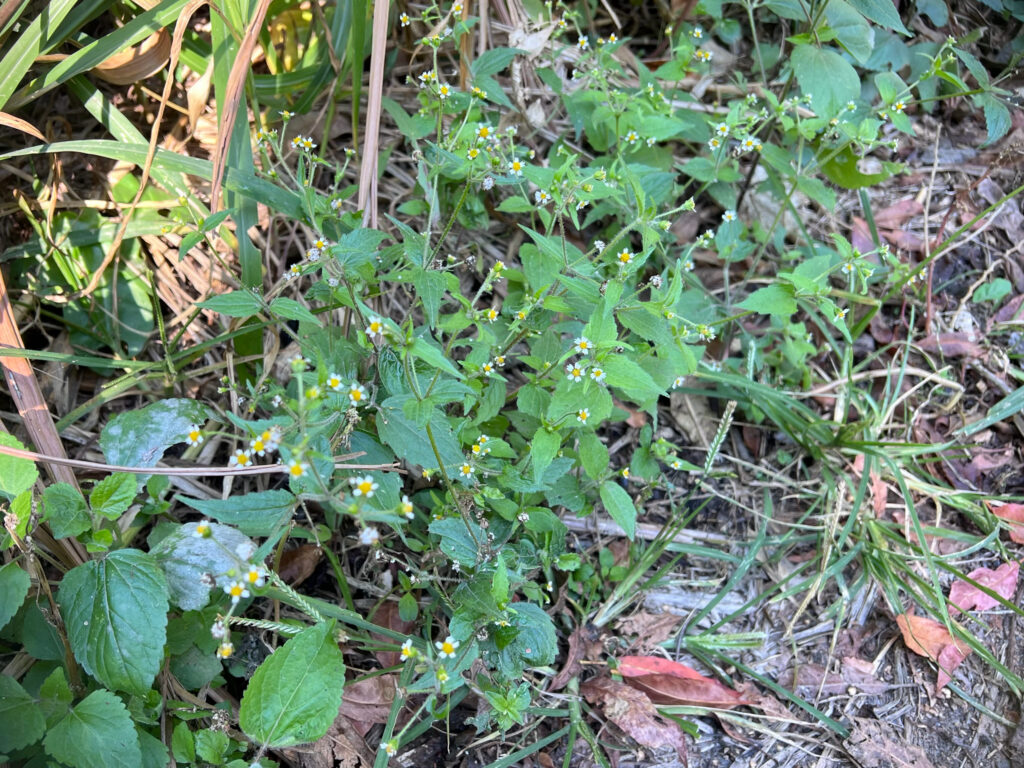
An introduced, weedy annual that has naturalized throughout North America. In New England, it appears as a summer and fall annual in disturbed areas, gardens, and field margins. Grows 6-24 inches tall with opposite leaves and small white flowers with yellow centers. Highly prolific seeder; can complete multiple generations in a single season. Prefers moist, disturbed soil. Often considered a garden pest due to aggressive growth and prolific seed production.
Safety & Interactions
Food use (as consumed as vegetable in South America) establishes a reasonable safety profile, though formal toxicological studies are absent. No known toxicity in traditional culinary use. Not traditionally used as a concentrated medicine in most Western contexts, limiting safety data for medicinal applications. The weedy nature and lack of documentation suggest caution and further research before medicinal use. No documented drug interactions from traditional use.
New England Specific
Shaggy soldier is a relatively recent introduction to New England, becoming more common in recent decades as global plant distribution shifts. Many New England gardeners know it primarily as a common garden weed rather than as a medicinal or culinary plant. The species represents both the challenges of invasive species and the potential for learning from plants used medicinally in their native regions.
Traditional Herbalism Information
Parts Used & Their Applications
The entire above-ground plant is edible and used medicinally in regions where it is traditionally employed. In South America, the young plant is harvested as a vegetable or green. In traditional medicine contexts, the entire herb (leaves, stems, flowers) is used. Both fresh and dried preparations are employed traditionally, though Western herbalists have minimal documentation of traditional methods.
Preparation Methods
As a vegetable: young plants are harvested and prepared like spinach or other leafy greens. Infusion: dried aerial parts infused in hot water for a mild herbal tea. Tincture: fresh or dried plant in alcohol (1:3 ratio), though traditional dosages are not well-documented. Poultice: fresh plant applied topically for traditional uses. Western herbalists lack clear traditional preparation methods, making standardization difficult.
Traditional Applications
In South American traditional medicine, used for inflammation, fever reduction, and general immune support. Applied to wounds and skin conditions. Some traditional use for gastrointestinal conditions and digestive support. Used as a general tonic or food rather than a concentrated medicine in many contexts. Traditional use as food and gentle medicine simultaneously reflects the plant’s mild nature and broad nutritional content.
Modern Adaptations
Contemporary Western herbalists have barely begun to incorporate shaggy soldier into herbal practice. The plant appears occasionally in ethnobotanical texts but is not part of standard herbal pharmacopeias. Some herbalists interested in learning from plants used in their native regions are beginning to explore shaggy soldier’s traditional applications. In South America and other regions, the plant is increasingly recognized as a wild food and traditional medicine worthy of scientific investigation.
New England Specific
The plant is known primarily as a common garden weed in New England. Few herbalists or gardeners recognize it as a traditional vegetable or medicine. As the plant becomes more established and climate changes create conditions favorable for its growth, there may be opportunity for New England practitioners to learn from South American traditions and experiment with the plant as both food and medicine.
Harvest Notes
Harvest young plants in spring and early summer for best tenderness and nutrient content. Can be harvested repeatedly by pinching off growing tips, encouraging bushier growth. For medicinal drying, harvest in late morning after dew dries, hanging in bundles or spreading on screens in shade. The plant grows so prolifically that sustainable harvesting is not a concern; rather, controlling its spread may be the challenge in gardens.
Magical Correspondences Information
Magical Correspondences
Planetary: Mars (drive, vitality, strength, action). Element: Fire. Associated with overcoming obstacles, persistence, and warrior energy. The prolific seeding and rapid growth make it a plant of manifestation and multiplication.
Magical Intentions
Used in magic for persistence, determination, and overcoming seemingly impossible odds. Employed in manifestation work due to the plant’s aggressive growth and prolific reproduction. Associated with warrior energy and standing one’s ground. Used in magic for rapid change and swift action. The plant’s ability to thrive in disturbed conditions makes it useful for magic addressing resilience and thriving despite challenges.
Ritual Uses
Shaggy soldier is carried or worn as a talisman for persistence and warrior spirit. The plant is used in Mars-ruled spells and working magic intended to create rapid, undeniable change. Some practitioners use it in protection magic and boundary-setting work due to its aggressive nature. Seeds can be included in prosperity and abundance magic due to prolific seed production.
Color Correspondences
White flowers (clarity, purity, illumination), yellow centers (manifestation, solar energy, action, success), green foliage (growth, abundance). The prolific nature relates to multiplication magic and the color green’s association with fertility and growth.
Sabbat Associations
Lughnasadh (manifestation of efforts, the harvest, seeds ripening), Beltane (aggressive growth, boundaries maintained by force), Lammas (the work made manifest). Less associated with spring and more with the fullness and abundance of late summer when the plant reaches peak productivity.
Traditional Lore & Folk Magic
As a relatively recent introduction, shaggy soldier lacks deep historical magical lore. However, its invasive properties and rapid spread make it emblematic of Mars energy and the unstoppable force. In regions where it has been used traditionally for longer, the plant may have more developed magical associations. The name “shaggy soldier” itself suggests warrior energy and determination in the face of challenge.
Combining with Other Plants
Works well with other Mars-ruled plants like garlic and chili peppers in manifestation work. Combines with ginger for intense action and rapid change magic. Pairs with nettles for strengthening and protection combined with Mars energy. Uses alongside black pepper for added intensity and power in magic intended to manifest quickly and visibly.
1. Oliveira, F., Schmitz, W., & Marquis, V.O. (1992). Galinsoga parviflora and Galinsoga quadriradiata (Asteraceae) Phytochemical and Pharmacological Research. Journal of Ethnopharmacology, 38(2-3), 105-112.
2. Jimenez-Estrada, M., Flexas, A., & López-Valles, I. (2007). Determination of Antioxidant Activity of Extracts from Galinsoga parviflora and Galinsoga quadriradiata. Pharmaceutical Biology, 45(10), 881-888.
3. Ramirez-Moreno, E., De Jesús, N., & Saldaña, G. (2011). Anti-inflammatory Activity and Phytochemical Profile of Galinsoga Parviflora Cav. Molecules, 23(9), 2133-2152.
4. Viuda-Martos, M., Ruiz-Navajas, Y., Fernández-López, J., & Perez-Álvarez, J. (2008). Spices, Herbs and Their Bioactive Compounds: A Review of Their Antimicrobial Efficacy. Critical Reviews in Food Science and Nutrition, 48(6), 496-510.
5. Martínez, G.R., Cogliati, B., & Radi, R. (2000). Hydroxyl Radical Formation during Cytochrome c Oxidation by Cytochrome c Peroxidase. Journal of Biological Chemistry, 275(46), 35957-35963.
6. Pereira, C., Calhelha, R.C., Abreu, H., et al. (2013). Analysis of Bioactive Compounds and Biological Properties of Galinsoga parviflora Herb. Food Chemistry, 139(1-4), 671-677.